
So . . . it’s NOT a snow day as we all predicted and hoped for. Well, that’s embarrassing and discouraging.
But no matter–it gives us time to START ON THE POETRY PACKET I assigned for over the break. Yay us!
VICTORIAN-ERA POETRY
I say “Victorian era” because two of the three poems are actually American, but contemporary and of similar style to Victorians. I want you to complete this packet over the break, but we have time to begin the first poem and class now, so we will.
Here’s the assignment:
February Break Work—AP Literature, periods 1 and 4
(This is not to punish you but to keep us on schedule because of our snow days. I don’t anticipate these tasks taking more than three hours. Be kind to yourself and finish them early, before the break even, so you don’t have to stress it. You’ll have all of your ideas written down, so you don’t need to worry about forgetting anything.)
Task One: Poetry
- READ the three Victorian-era poems (one British, two American, so technically not “Victorian” but the same time period) which are elegies—a poem in honor of someone who has died; and narratives—a poem that tells story.
- MARK up the text of the poems with whatever notes you can produce. Notice if there’s a rhyming scheme, or alliteration, or repetition. Jot down ideas in the margins—there’s lots of space. Identify figurative language, metaphors, whatever else you see in there, and record any comments that you have. (You WILL turn these back in to me after the break and you WILL earn points for marking the text.)
- CREATE A RESPONSE for each poem about what you discovered in it. Follow SLAM. This is not a formal essay, rather a way to list all that you discovered in the poem. It may be best to follow the outline of SLAM: first list what you discovered about the Structure, then the Language, then the Affect, then the Meaning. Write it up however is comfortable for you—bullet points, paragraphs, lists, whatever. The purpose is to create a page where you put down everything you discovered and understood in the text. You will have a total of THREE pages, one for each poem.
- RECORD questions that you have for each poem. I don’t expect you to understand them fully, and I expect you to bring some questions when we come back to class. List those on the bottom of your responses.
Task Two: Sentence Combining
You can frequently make your sentences more sophisticated by combining shorter, simpler ideas into longer, more complex ones. Complete the three Sentence Combining pages, writing your answers below the line, to practice the different ways sentences can come together.
*We will discuss the poetry when I return on Wednesday, Feb. 26. You will have a substitute on Monday and Tuesday, Feb. 24 and 25, who will do something else with you. So hold on to this assignment and turn it in on WEDNESDAY the 26th.
Today we will discuss Walt Whitman’s “O Captain, My Captain”
. . . and dissect it in class. (The first poem in your packet.) This was written in 1865, so think back to your American history and think what significant events were occurring in the US at that time. (Here’s a hint: Civil War and Abraham Lincoln.)
Forgive the quality of my bad camera phone, but here’s a snapshot of what we identified during class Period 1:
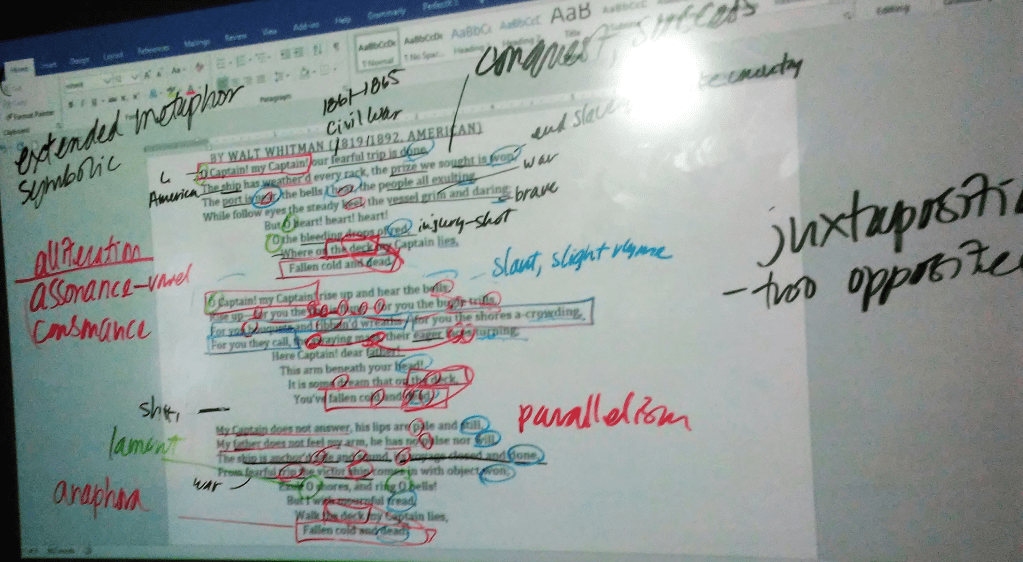
This is what I want you to replicate on your own page–mark up the text however much you can, looking at rhyme schemes, figurative language, symbols, meanings, diction, repeated phrases (anaphora), parallelism, repeated sounds (alliteration, consonance, assonance), etc., and ASK QUESTIONS. For example, why isn’t his rhyme scheme consistent? Why are there slant/close rhymes in some places and not in others? Why is there a shift between the 2nd and 3rd stanzas? What is this about, anyway?!
I want you to find as much as you possible can in each poem, then write down everything you find in a list, or bullet points, or a paragraph if you want, etc. Document your findings because we’ll discuss these when we return from break (on Wednesday, Feb. 26, because I’ll be gone on Monday and Tuesday). Remember to also do the Sentence Combining assignment.
HINT: For “Charge of the Light Brigade,” you may want a little background if your knowledge of Crimean War history is rusty: https://www.wearethemighty.com/articles/the-story-of-the-charge-of-the-light-brigade-makes-your-officers-look-pretty-smart
Remember that tomorrow is FIELD DAY, so there’s no class on Friday.
 AP Lit, Washington Academy