
Hamlet Act 1:3-5
WATCH the 2009 production from 21:00–43:05
We meet the ghost! Or do we . . .
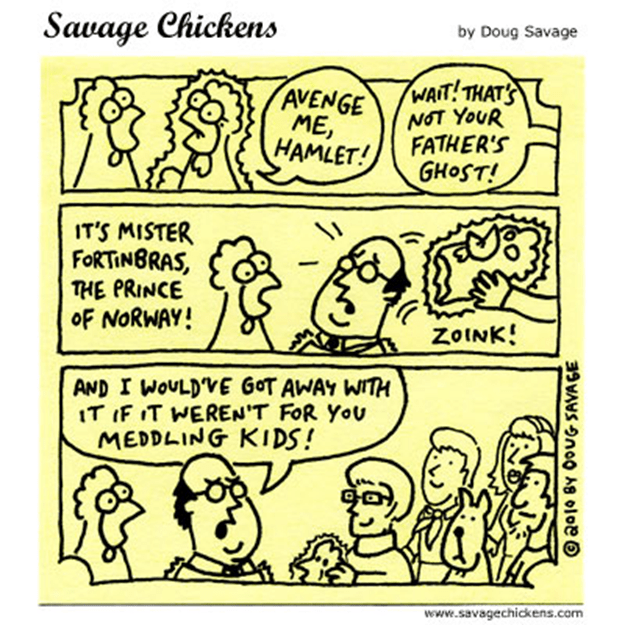
Alas, Scooby and the gang aren’t around yet, so we have to take the ghost at his word. Or so believes Hamlet.
But first. Ophelia and her family. What’s her relationship with her brother? Genuine? What kind of advice does he give her? What advice does she give him in response?
Enter Polonius–ah, Polonius. Many people have tried to figure him out. He gives a lot of advice, and we’re going to look at it. How much is good? Is self-serving? Is reliable? What kind of a dad is he? How would we characterize him?
Now, another young man and his dad–Hamlet, and his Ghost Daddy. With Horatio and Marcellus, he waits for the ghost, and when it appears, how do his friends react? (We should all have such good friends.)
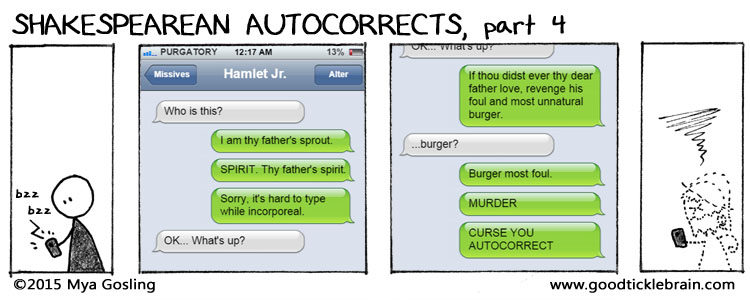
Hamlet meets privately with the ghost where he hears about murder most foul.
It’s important to understand some of the allusions presented in this scene. Shakespeare refers subtly to the Garden of Eden, and Cain and Abel. We’re going to go over those stories from Genesis. (If you want to read the full stories, read Genesis chapter 2-4.
- Adam and Eve placed in the Garden of Eden.
- Told not to partake of the Tree of Knowledge of Good and Evil.
- The devil, as a serpent, “beguiles” (coerces) Eve to partake of the fruit.
- She convinces Adam to do so as well.
- They are cast out of the Garden of Eden, become mortal, but now know enough to begin having children and getting the human family going.
- Among their children are Abel and Cain. Abel’s the good one, offering proper sacrifices. Cain’s the unrighteous one, listening more to Satan. His sacrifice is rejected by God because Cain really loves Satan.
- Cain, furious, rises up and kills his brother so that he can have all of his brother’s wealth.
- God notices and curses Cain.
See any connections to what’s happening in Hamlet? Where’s King Hamlet when he’s poisoned in his ear? Who does he say does this? Who is the other person involved in this scheme? What does Claudius get after his brother’s death?
Learning of how King Hamlet dies sets of Hamlet jr., which is convenient because what does his father want him to do? Avenge him!
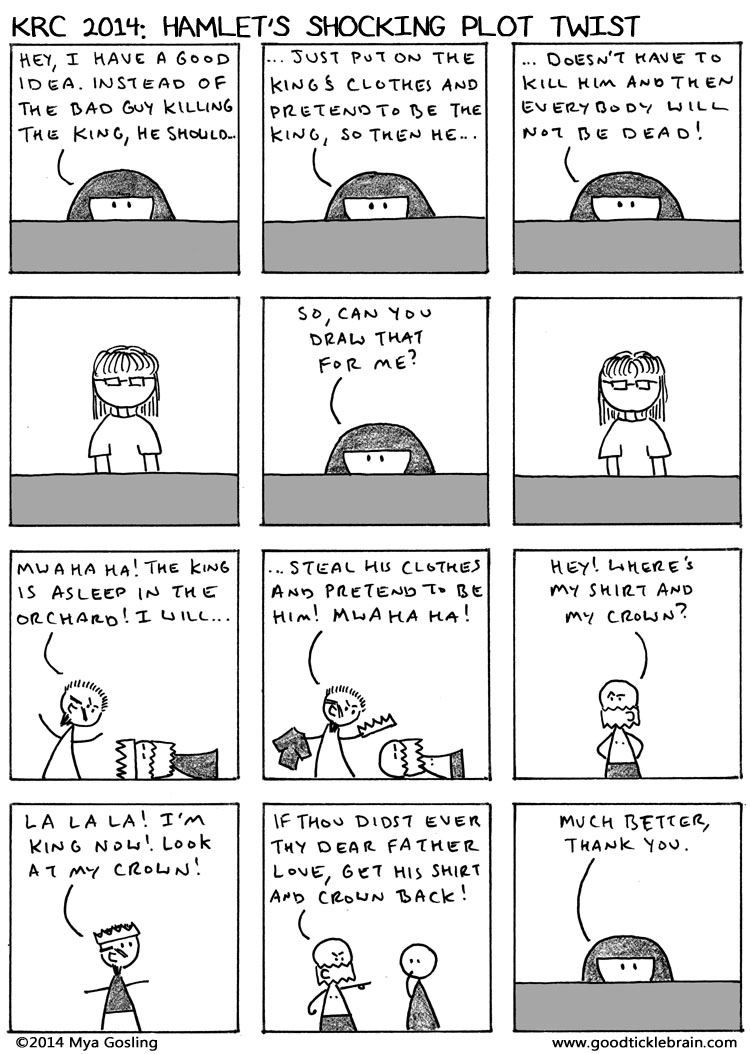
Hamlet agrees, saying he’ll put all other thoughts from his mind and focus solely on vengeance, since his father is suffering since he was denied the ability to repent before his death, and now suffers in purgatory, burning away his sins until he is good enough to get into heaven.
Hamlet decides to put on an “antic disposition” and feign madness while he works through this plan. What does he ask Horatio and Marcellus to do for him? Again, super great friends. Be that friend who doesn’t tell the court that the madness is all pretend.
Here’s an excellent analysis about how audience would have reacted then, from Cliff Notes:
King Hamlet’s ghost introduces himself in a way that most certainly evoked the sympathy of the Elizabethan audience. He tells Hamlet that his brother robbed him of everything he was, all that he owned, including his everlasting soul. In the same way that the Bible engenders sympathy for Abel and condemns Cain for the fratricide, Shakespeare favors the murdered brother.
Hamlet is quick to believe the Ghost because the spirit’s words confirm his worst fear: Claudius murdered King Hamlet. For the Elizabethan/Jacobean audience who attended the first performances of Hamlet, murder of a king was in itself cause for alarm. Consider that the English people believed that their monarchs ruled by Divine Right, that God Himself appointed them to rule the land. The Church of England went so far as to attribute to the monarch the highest order of executive power in the church as well. In all ways, the English monarch represented God on earth. King Hamlet’s murder makes the Ghost a most sympathetic figure to Shakespeare’s audiences. No one would have questioned the existence of that Ghost, and few would have believed — even for a moment, as Hamlet does — that the Ghost could be a devil.
The fact that his mother’s lover is also her husband’s murderer exacerbates Gertrude’s crime of incest. Hamlet is bereft of choice. He may have an aversion to violence, and he may live by strict Christian principles, but he must avenge his father’s honor. Hamlet sees no way to honor his father except by killing Claudius. Doubly impelled by his father’s orders and by tradition, Hamlet becomes a prisoner of his obligation for revenge.
Hamlet is a sympathetic character precisely because the notion of revenge drives him while his Christian morality and inclination simultaneously exhort him to be charitable.
On the other hand, Gertrude is a woman who has been led by her weakness and frailty to follow the charismatic devil of a king to his bed.
Hamlet tells Horatio that he plans to feign madness before the King and the court. The madness will render him invisible so that he might observe and discern the best way and time for his revenge. Hamlet’s meaning here remains ambiguous. Is his madness a mask?
https://www.cliffsnotes.com/literature/h/hamlet/summary-and-analysis/act-i-scene-5
And an explanation as to why Hamlet keeps shifting ground during the “SWEAR!” scene:
WHY HE KEEPS SHIFTING GROUND DURING THE OATH: But, further, it is to be observed that he does not merely propose the oath afresh. He first makes Horatio and Marcellus swear never to make known what they have seen. Then, on shifting his ground, he makes them swear never to speak of what they have heard. Then, moving again, he makes them swear that, if he should think fit to play the antic, they will give no sign of knowing aught of him. The oath is now complete; and, when the Ghost commands them to swear the last time, Hamlet suddenly becomes perfectly serious and bids it rest. [In Fletcher’s Woman’s Prize, V. iii., a passage pointed out to me by Mr. C. J. Wilkinson, a man taking an oath shifts his ground.]
 AP Lit, Washington Academy