
Hamlet Act 4:1-4 (Ophelia’s mourning, Hamlet’s escape, Laertes’ return, Ophelia’s horticulture and swimming lessons) (because there’s some confusion as to which act and scene is which, for those following in No Fear Shakespeare, this is what you should have read)
The 2009 production skips quite a bit and cuts a lot of dialogue, but the best parts are retained. We’ll watch from 2:15:02 to 2:34:47 (about 20 minutes).
The front cover of your book is Sir John Everett Maillas’ painting of Ophelia, completed around 1850. Here is it fully:

Main points of this reading:
Ophelia’s reaction to her father’s death–does she love him? What’s Gertrude’s reaction to Ophelia wanting to see her?
Laertes is quite upset with Claudius, and what’s his “natural” assumption about the cause of Polonius’s death? That Claudius did it? Now, why would he assume that? (They hastily buried Polonius–no state funeral with military honors as he was supposed to receive.) Laertes is highly suspicious. Does he suspect Claudius had something to do with King Hamlet’s death?
Enter Ophelia with her horticulture lesson. She’s clearly mad, but also very brave, tossing around insults as well as sorrow. Flowers had meanings, even way back then, and she lectures them as she gives them flowers. (In some productions, she hands out nothing but only acts as if she has flowers.) In this one, she hands out various weeds and calls them whatever.
Here’s an explanation someone else once put together, which I stole:
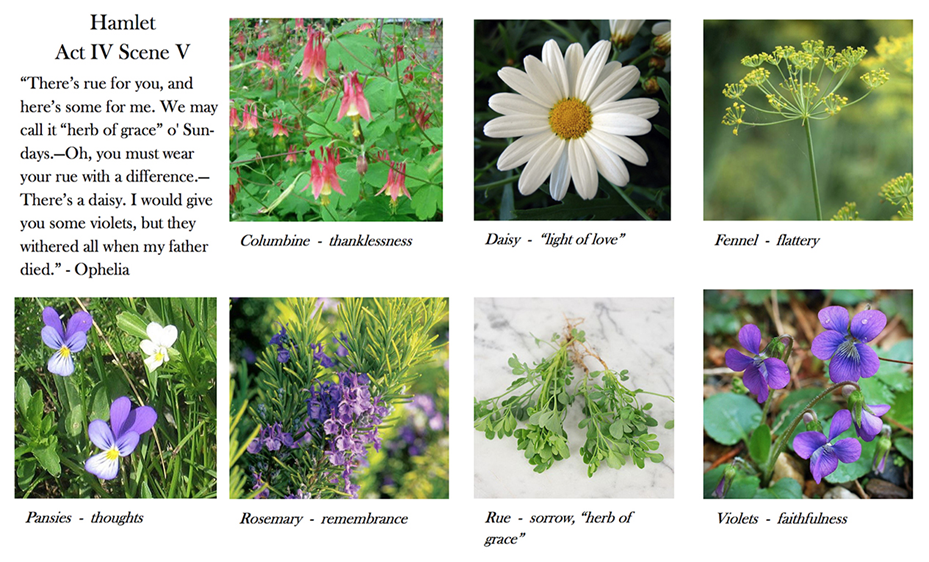
To Claudius, she gives flowers that represent flattery and ingratitude, and to Gertrude she gives her rue which is for both repentance and sorrow, so when she says that Gertrude needs to wear hers with a difference, she means for Gertrude it’s repentance, for Ophelia it’s for sorrow.
And, according to the songs Ophelia sings, what kind of relationship might she have had with Hamlet? A little more involved than anyone knew, perhaps?
The reactions of Laertes and Ophelia open an interesting question: just how guilty do they think Gertrude and Claudius are regarding King Hamlet? And does the rest of the castle, and indeed Denmark, think they are guilty of some misdeeds as well?
Remember how we discussed appearances and reality yesterday? Maybe the reality of Denmark and its people is that they suspect Claudius and Gertrude of poor behavior. The facade (appearances) they’ve held up is crumbling.
So that’s why Claudius comes up with strategy #2 for killing Hamlet, who has escaped by reason of some helpful pirates. (Ah, the helpful pirates! So many stories written about them . . . Well, there should be.)
After convincing Laertes that he didn’t kill Polonius, and that Hamlet did, Claudius proposes Laertes and Hamlet have a fencing match, but he’ll assure that Laertes’ sword is unblunted–sharp–so he can stab Hamlet (plot #2).
And if THAT doesn’t work, Laertes just happens to have a vial of poison on him (seriously, who goes around with a vial of poison? What does that suggest about his character?) (plot #3, or 2b, since it builds off of Claudius’s plan).
And if THAT doesn’t work, Claudius has another backup plan–which he comes up with in about five seconds, proving that he’s becoming more adept at plotting deaths at a moment’s notice (good to have hobbies): he’ll have a glass of poisoned wine (plot #4).
One of those three methods ought to kill Hamlet, right? (Come on, Claudius–it was easy to bump off your brother, why are you struggling so much with your nephew? Sheesh. What kind of villain is he?)
Then, we have Ophelia’s death, reported by Gertrude. It’s quite a romantic scene, as you can tell from the painting, a lovely girl dying because her lover killed her father.
But it’s also full of questions: who witnessed this? Did anyone try to help the poor girl?! And, a big question worrying Elizabethans–did she commit suicide? (Remember Hamlet’s speech “To be” and the big questions? What about Ophelia?)
A few more important points:
Appearances: How often is Claudius trying to make everything look “right”?
FOIL—not the mathematical kind, and the fencing kind (that’s tomorrow) but the literary kind: someone else in a similar situation held up to our protagonist as an example of another way to handle the same problems. We have three for Hamlet in these scenes.
First, Laertes–how quickly does he act to get revenge for HIS father’s death? (We’re still waiting, Hamlet.)
Second, Ophelia–how quickly does she go insane and die? (Hamlet, is your craziness even real?)
Third, Fortinbras–we haven’t even met the guy, but he’s engaged 20,000 soldiers to fight for a tiny cause his father lost, just to prove his honor. (Hamlet, how many soldiers have you engaged? Kind of sad, buddy.)
And Hamlet knows he’s pathetic compared to Fortinbras (he doesn’t yet know about Laertes and Ophelia). Nonetheless Hamlet does what he does best: he sits and stews and feels guilty.
Here’s an interesting question, a twist on what you may expect: Perhaps Hamlet’s response is because he IS so sane, and not insane. Would a sane man really rush in to revenge? Maybe his real problem is that he’s not crazy enough.
Maybe Laertes, Ophelia, and Fortinbras as making very poor choices in the same circumstances, and Hamlet is the proper one demonstrating how to do things better.
If that’s the case, who is being “better”? What, really, should Hamlet do next?
HOMEWORK: Read Act 5:1. You may skip the “Clowns” speaking and go straight to Hamlet and Horatio entering the scene. The beginning of this scene made a lot of sense back in Shakespearean times–it was meant as a “light” moment after so much heaviness in the play, and all of the jokes were funny at the time. Now, none of us have any idea what any of it means, so like everyone else who attempts to read it, we skip it instead. Create 1 HamLog.
Because it’s a short reading assignment, I’m also going to give you 10 more questions from an AP Lit Exam from 2012. Read the poem on page 8 (dated 1667, so it’s similar language to what we’re dealing with right now) and answer questions 24-33. Spend ONLY 10 minutes on these.
 AP Lit, Washington Academy