
Shakespeare! Wait, more? Yes! SONNETS!
We’ve spend a couple of weeks on one of his plays, now we’re going to spend just a couple of days on his poetry.
He’s not the only one to write sonnets. Here’s a lovely, modern one from Billy Collins:
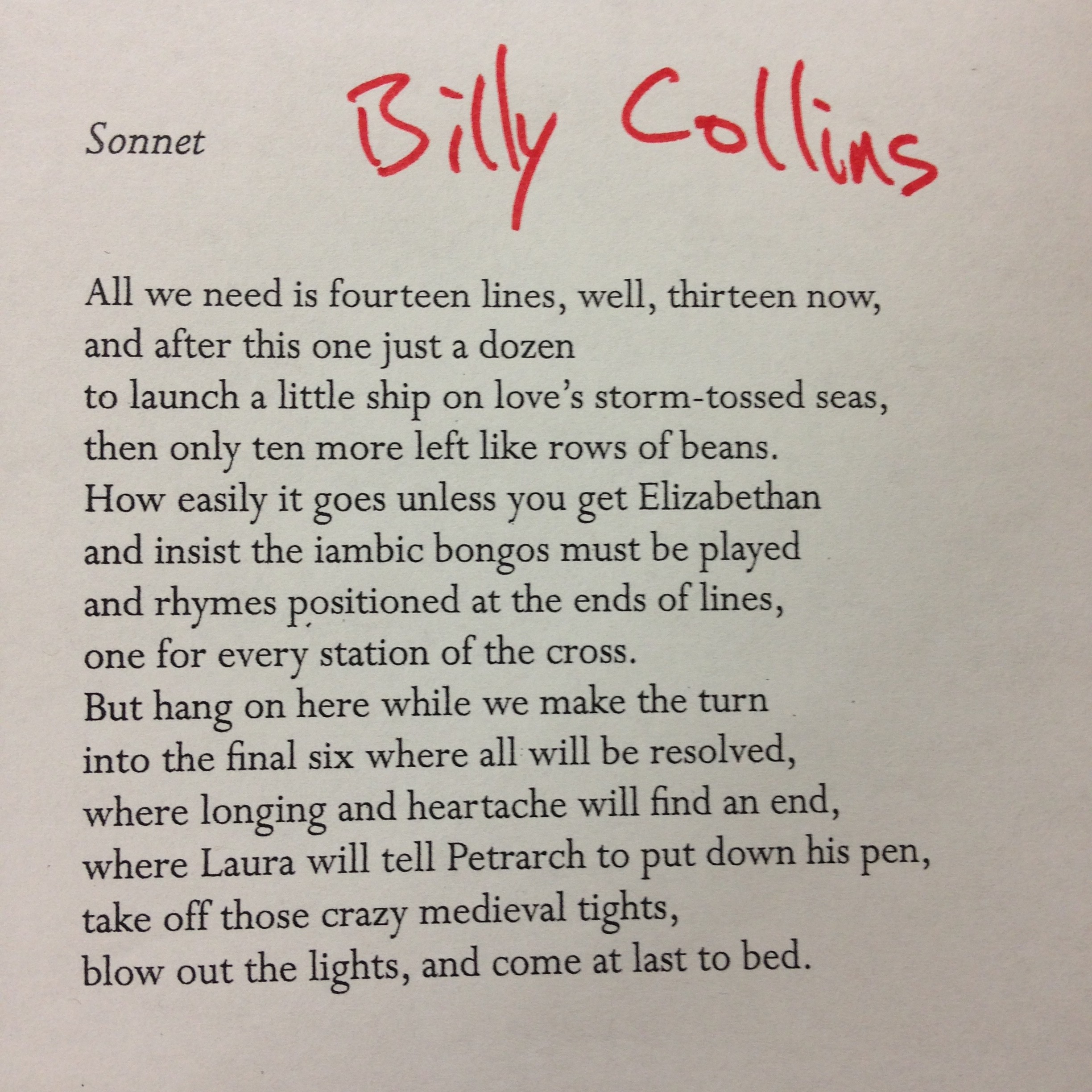
Sonnets follow a very strict format:
- 14 lines; the first 8 “create a situation,” the last 6 “resolve” it
- predictable rhyming pattern (usually in Elizabethan it’s abab cdcd efef gg, or sometimes aabb ccdd eeff gg for those wild Elizabethans, or another variation, such as Petrarchan with abba abba, then cdcdc or cdecde; Petrarchans are a bit looser in construction–the party boys of Renaissance poetry)
- usually in iambic pentameter (five “beats” each going “ta-DA”) although occasionally Shakespeare played with a different beat (here’s an interesting Ted Talk about iambic pentameter: https://www.youtube.com/watch?v=I5lsuyUNu_4)
- stolen from the Italians (it’s sooo much easier to rhyme in Italian than in English; nearly everything in Italian ends in an “ia” or “io” so sonnets are less of a challenge to write in Italian. Cheaters.)
Theme: Shakespeare’s sonnets tend discuss one of three themes: (1) the brevity of life, (2) the transience of beauty, and (3) the trappings of desire.
Literary devices: These frequently crop up in Shakespeare’s sonnets.
- alliteration
- assonance and consonance
- antithesis
- anaphora
- enjambment
- oxymoron
- personification
- internal rhyme
Together we’ll go through Sonnet #18 “Shall I compare thee to a summer’s day?” marking everything we can find, from the rhyme scheme and the stressed and unstressed syllables of the iambic pentameter, to all of the literary devices and sound devices.
HOMEWORK: Your turn! Here is a collection of sonnets from which you’ll choose ONE. Read them all, see which one appeals to you most. Mark up that ONE sonnet as thoroughly as possible. THEN you’ll write it up as thoroughly as possible. Follow Sonnet Analysis which will have examples of what we explored today in Sonnet #18. On Monday we’ll go over all of the sonnets, and when we start to discuss yours, you better speak up and tell us what you found!
Your marked-up poem and analysis are due Monday for class.
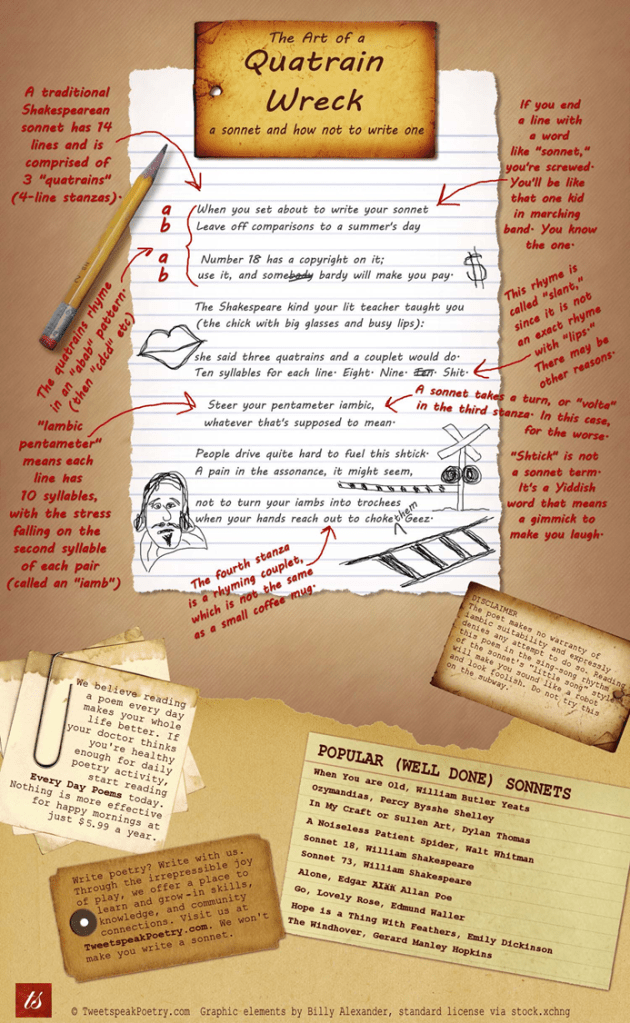
And no, I won’t make you write a sonnet, but here’s some advice if you want to:
 AP Lit, Washington Academy