UPDATE ABOUT AP TESTING! Straight from a head honcho at AP:
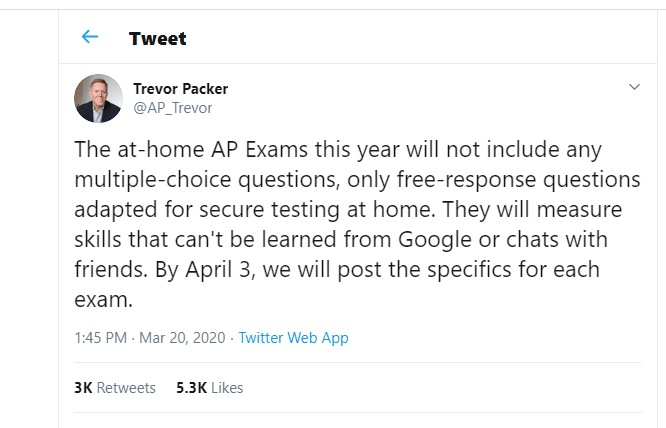
What does this mean? We will have only ONE essay to write, online, AT HOME. These are the same essays I’ve been making you hand write, but NO MORE! You WILL be able to type this! (So all of our hand writing practice is for naught, naturally.)
There will also be NO multiple choice questions (which many of you seemed to loathe anyway).
What the essay will be about–over a poem, or over prose, or an open-ended question about a book–we do NOT KNOW YET! April 3 is the magical date, and right now that feels so far away.
So until I know more, we’ll be practicing writing essays for poems and prose, which we haven’t done too much of yet. Your last batches of Hamlet essays were–I’m very pleased to report–pretty darn good. You’re getting better at succinctly stating the thesis, providing evidence (as much as possible) and summing it all up.
So the next two weeks, we’ll be reading The Adventures of Huckleberry Finn and analyzing poetry. Once I hear what’s happening with the AP Exam, we’ll refocus efforts toward that.
It looks like we have TWO test dates now. I copied this from the College Board website Saturday morning:
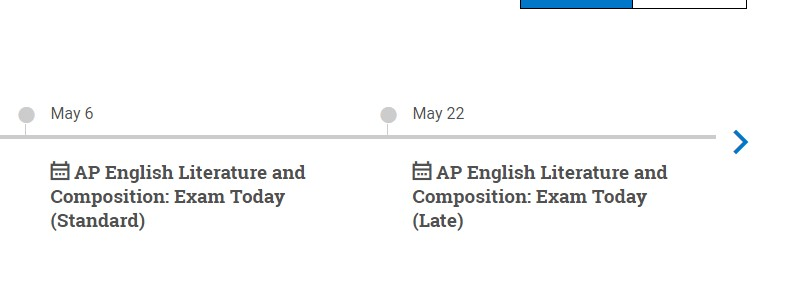
What I think this means is that if you want to take the test as previously planned–Wednesday, May 6–you may do so. If you want a few weeks more of practice, to take it on Friday, May 22, you may. I imagine they’ll be two very different tests, so you won’t be able to ask your buddies who took it earlier what it was about. Nor do I know yet if an entire school has to take it at the same date or not. I imagine all will be clarified by April 3.
That’s how things stand on Saturday, March 21. By now we know that everything may be different again by Sunday, and again by Monday. What a heckuva year this week has been . . . So onward! To new adventures!
The Adventures of Huckleberry Finn! And we’re having Adventures in Online Learning!
Friends, it’s come to this: the dream of all introverts. School at home. We’ll do our best.
But first, a high school friend who took AP Lit with me sent me this, for all of you:

You’re next assignment is to write a Shakespearean Play, due Friday. No? Fine. We’ll read instead.
I’ll try to set up each day in THREE PARTS:
- LESSON
- READING ASSIGNMENT
- WRITING ASSIGNMENT
Knowing me, I’ll forget this line up, but for today it feels organized.
PROCEDURE:
I will try to post each lesson the night before, then I’ll be available to chat with you online during “Class Time.”
Here’s WA’s official schedule:
- PERIOD 1 10:00 to 10:30
- PERIOD 2 11:00 to 11:30
- LUNCH 11:30 to 12:30
- PERIOD 3 12:30 to 1:00
- PERIOD 4 1:30 to 2:00
But I will be online for most of the day/evening, so you may email me, Google Chat with me, message me on Facebook, or try screaming really loud, and I’ll do my best to respond in each and every way.
LESSON:
The Adventures of Huckleberry Finn, (referred hereafter as Huck Finn) by Mark Twain, is one of the most famous and controversial books in America.
Remember the Civil War? That was in 1861-1865. This book was written 20 years after slaves have been granted freedom, in 1885, but set several years before the Civil War broke out, around the 1840s (lost yet?). Even though slaves were “freed,” things didn’t improve for blacks for many decades.
That bugged Mark Twain. He especially hated the hypocrisy he saw in America, which was most prevalent in the south. Watch this 3 minute video about America’s most famous author. He was also called the “First Celebrity” since he was the first to develop a “following.” (Think Instagram star, but he’d be InstaGramp. He even knew how to sell himself–hint, it’s a white suit.)
Notice what he was doing at age 15.
The video mentions the “vernacular speech,” which is part of why this book is controversial, and also why it’s difficult to read. (Don’t worry, you can read it No Fear version here.) Twain wrote how people spoke, and when you look at the text, you’ll see that some of it can be very difficult to decipher:
“Don’t you give me none o’ your lip,” says he. “You’ve put on considerable many frills since I been away. I’ll take you down a peg before I get done with you. You’re educated, too, they say—can read and write. You think you’re better’n your father, now, don’t you, because he can’t? I’LL take it out of you. Who told you you might meddle with such hifalut’n foolishness, hey?—who told you you could?”
See? The other issue is the “n” word. It shows up a lot, because it was standard language in 1885. While the “n” word is extremely derogatory now–and we will NOT write it or use it–it was simply an accepted term 150 years ago. That does not make this book racist, as some claim it is. Quite the contrary; Mark Twain was all about fighting racism, as you will see in the reading. Be forgiving of their language use–the language wasn’t offensive when he wrote it.
If you want to hear how the slave Jim and Huck Finn would sound read out loud, I found this video clip of Bill Murray years ago reading a “deleted” chapter from Huck Finn. You don’t need to listen to all of it, but may for a minute or so, to hear the vernacular. Both Huck Finn and Jim have different ways of speaking. It’s really quite a feat to be able to write this way. Twain had an excellent ear for dialects and captured this remarkable well (START at about 1:20 and listen for a minute or so):
MAJOR THEMES in Huck Finn (according to one source)
- Slavery: When Mark Twain wrote this book, slavery had been abolished; however, black people were still treated as second class citizens. The fact that Huck befriends Jim, a runaway slave, and saves him in the end plays on this theme.
- Freedom: Going hand in hand with the theme of slavery is freedom. Huck wants his freedom from his father. Jim wants his freedom to be a human being and be with this family.
- Adventure: One of the most entertaining Huckleberry Finn themes is the theme of adventure. At the beginning of The Adventures of Huckleberry Finn. Huck is tired of “playing” at adventure with Tom Sawyer. Then his pa comes back and Huck’s real adventure on a raft down the Mississippi River begins.
- Money/Greed: The characters in this Mark Twain book, who care more about money than people and are overcome by greed, are often suffering. This theme shows the reader that money and “being civilized” is not what is important in life–friends, family, honesty, loyalty–these are the important things. Huck’s pa is a perfect example of the disastrous nature of greed.
MAJOR THEMES in Huck Finn (according to another source)
- 1. Man can be inhuman toward his fellow man. (morality)
- 2. Society’s values and laws can be in conflict with higher moral values. (hypocrisy of society)
- 3. People must live outside of society to be truly free. (freedom)
- 4. Growth of self occurs through close, honest observation of society and the individual. (maturity)
- 5. Gullible people are partially responsible for their own deception. (superstition, ignorance)
ALL of the above plays in this book which is NOT a children’s book (as some people who have never bothered to read it think it is) but it a complex analysis of society and ultimately asks the question, When and how should you rebel against what “society” is telling you to do?
Here’s a difficult yet telling modern day example of this theme: Would you really have spoken out against slavery? (You don’t have to answer that question, but think about this scenario.)
By Robert P. George
Something tells me it’s time to re-post this comment:
Undergraduates say the darndest things. When discussing the history of racial injustice, I frequently ask them what their position on slavery would have been had they been white and living in the South before abolition. Guess what? They all would have been abolitionists! They all would have bravely spoken out against slavery, and worked tirelessly in the cause of freeing those enslaved. Isn’t that special? Bless their hearts.
Of course, it is complete nonsense. Only the tiniest fraction of them, or of any of us, would have spoken up against slavery or lifted a finger to free the slaves. Most of them—and us—would simply have gone along. Many would have supported the slave system and, if it was in their interest, participated in it as buyers and owners or sellers of slaves.
So I respond to the students’ assurances that they would have been vocal opponents of slavery by saying that I will credit their claims if they can show me evidence of the following: that in leading their lives today they have embraced causes that are unpopular among their peers and stood up for the rights of victims of injustice whose very humanity is denied, and where they have done so knowing
(1) that it would make THEM unpopular with their peers,
(2) that they would be loathed and ridiculed by wealthy, powerful, and influential individuals and institutions in our society;
(3) that it would cost them friendships and cause them to be abandoned and even denounced by many of their friends,
(4) that they would be called nasty names, and
(5) that they would possibly even be denied valuable educational and professional opportunities as a result of their moral witness.
In short, my challenge to them is to show me where they have at significant risk to themselves and their futures stood up for a cause that is unpopular in elite sectors of our culture today.
Tough to think about, isn’t it? Many of the modern issues we stand for now are also represented by those in power. But what if we believe contrary to those in power (Hollywood, media, social media, etc.)? Would you dare speak up?
Anyway, moving on. Each day you’ll have a reading assignment and a set of questions to answer. You can create a HF Log like we did our HamLogs. But this time you’ll answer specific questions, to make sure you understand the text since we won’t be in class to discuss it.
READING ASSIGNMENT: Read Chapters 1-3 of Huck Finn on this link in No Fear Huck Finn.
Do your best to give the actual text a shot–it isn’t as difficult as Shakespeare, but for those of you for whom English is a second language, you’ll appreciate the translation part, I’m sure!
WRITING Assignment: On your HuckFinnLog (or whatever you want to call it) write short responses (2-4 COMPLETE sentences) for each question on a Google Doc. (Keep updating the document as we did with the HamLogs.)

Chapters 1-3
- 1. Identify: Huck Finn, Tom Sawyer, Jim, Miss Watson and Widow Douglas.
- 2. Why doesn’t Huck get along with Miss Watson and Widow Douglas?
- 3. What does Huck think about religion, specifically the good place, the bad place, and prayer?
- 4. Give two examples of superstition in this section of the novel.
- 5. Contrast Huck and Tom. What are their main differences?
HERE are all of the chapters and the reading questions, in case you want to check the schedule for the future. This may be subject to change, and since I took it from another source, there were a couple of errors. I hope I’ve fixed them (questions didn’t line up with chapters) but there may still be some issues. I’ll update them as soon as I encounter them. You do NOT need to read ahead; this link is merely for your benefit.
We will spend roughly two and a half weeks reading Huck Finn. We will also do a few poems from this time period, and perhaps a couple other readings from Mark Twain or his contemporaries, I’m not yet sure.
I’m also trying to figure out how to annotate poetry as a Youtube video for you, and we may try to do a Zoom chat TWICE a week, if we can manage that. Meeting with Zoom will NOT be a requirement, just a “Hey! You’re out there! How’s it going?” kind of thing when you can manage it. Maybe on Tuesdays and Thursdays, at our “class time”? I’ll let you know.
PLEASE let me know how this process is going for you. TELL me your concerns, or what we need to clarify, or what you think would work better, etc. (no homework is NOT an option, by the way). I can modify as we go along, I can try making videos of me lecturing to you (I may do that when we analyze the poems), I can try different strategies–GIVE ME FEEDBACK! I can’t guarantee anything, but lets keep looking for ways to make this situation better. I miss you all already! (Seriously, I love, love listening to you argue in class, and it breaks my heart a little that we won’t be doing this for a few weeks.)
 AP Lit, Washington Academy