April 8, 2020 (Thursday)

Prose Prompt Practice #2–the 2018 Exam Question

Here’s our Zoom Meeting from this morning with Period 1. Period 4 will be similar (but not recorded). Watch this to clarify what’s discussed below:

First, let’s address a few issues I saw in yesterday’s assignment:

  • Something horrible happened over the past two weeks: many of you have lapsed back into wordiness. You’re wasting a lot of time to get to the point. Don’t. Sorry, but intros like this are useless because they say nothing: “Twain uses many literary devices to characterize Pap Finn. Some of these devices are imagery, dialect and behavior. These all show what kind of a person Pap is.”
    NO! Cut and get RIGHT TO THE POINT: “Pap Finn is an insecure, abusive, disgusting father, which Twain illustrates through gross imagery, poor grammar, and threatening behavior.” That’s all your intro needs to be. State exactly what he is and how we know it.
  • Do NOT waste time defining lit terms or devices. Trust me–the readers know what they are. “Diction is the choice of words that an author uses . . .” NO! Cut and MAKE YOUR POINT!
  • Stick to the passage. If you can’t prove it from the passage, do NOT assume it or pretend it’s there.
  • Any assumptions you make you MUST prove them. I will not buy a suggestion that maybe Pap actually loves his son. I see no love in that passage. Prove it!
  • TIGHTEN your sentences! They’re fluffy again–STOP IT! We hate fluff! Do you know what fluff means? You’re afraid to get to your point. You’re stalling. It’s weak! Stop being weak!
  • Ask yourself, “How would Ron Swanson write this?”
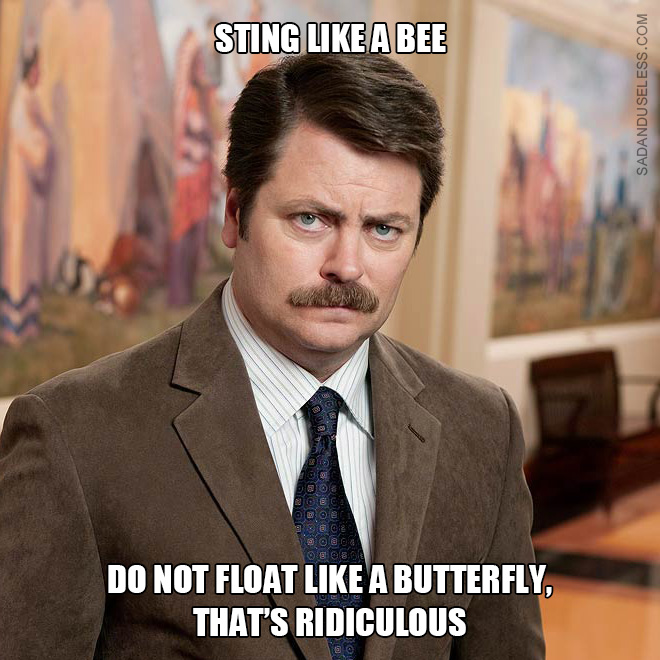
Sting like a bee. Do not float like a butterfly. That's ridiculous.

Or when you are hesitant when you write, or are making any of the errors above, think of me glaring at you like this. Remember–we HATE fluff:
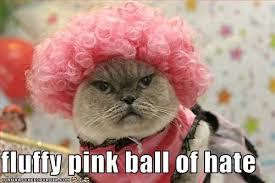
fluffy pink ball of hate - Cheezburger - Funny Memes | Funny Pictures

We’re going to do something a little different today. On Wednesday, someone on the AP Lit Facebook page posted an interesting assignment that I realized would pair well with the prompt writing you just completed. So you’re getting today the same assignment that about 50 other schools (judging by the amount of teachers like me who said, “Ooh, good idea. Going to steal this, thanks!”).

Here’s the assignment: Read the passage as if you were to write the essay. Take notes as you read it. If you can, print it out and annotate it. It’s Question 2 (on page 3). https://secure-media.collegeboard.org/apc/ap18-frq-english-literature.pdf?fbclid=IwAR3SxWPG-btazBNmk-dz_Z1NbOEKLhosR7sNdtTH6HtDJowdpDYtSr0BT20 (This is the exact exam students took two years ago–Rosemary, Mailena, Hailey Bell, Isaac, etc. Yes, pity them.)

Take a close look at the prompt: ” . . . analyze how Hawthorne portrays the narrator’s attitude toward Zenobia through the use of literary techniques.” This is similar to the Huck Finn “analyze the character” prompt and what literary techniques were used. This is wanting you to look at how the narrator feels about the woman he’s addressing. So first discern how he feels about her, then look closer at the text to see WHAT methods Hawthorne used to show us those feelings.

Now, once you’ve read through this, then made some notes for yourself, do NOT write the answer yet. Instead, read the blog below where two of the AP Exam readers/scorers discuss what students did wrong and right in writing this essay:

READ this blog http://www.aplithelp.com/question-2-reflection/?fbclid=IwAR17CIypnKQwaX7QVRX7eXruaidQROoogWdjc0PFKyQr12BotPxoHPbj2X4 Pay particular attention to the “take away” advice.

THEN write me out an OUTLINE of how you would answer this question. You do NOT have to write a full essay (if you want to, you certainly may), but create an outline with examples of what you would write, now that you know what’s the “right” thing to do.

(I learned from this blog that they do NOT like the word “diction” sitting all alone–it’s rather obvious that the author uses words–so avoid it. I also read on another blog that they HATE the phrase, “paints a picture” because every other student uses it. And they’re right; I haven’t finished grading but seven of you have used this phrase. Yeah, way overused.)

Try to avoid the errors the readers/scores explained in their blog. This outline will be due FRIDAY before midnight.

(I will give you another assignment of satire reading on Friday, but that won’t be due until Monday.)

April 8, 2020 (Wednesday)

AP Prompt–Characterization

We discussed this in our Zoom chat Tuesday, and I’ve made a video of how to answer such a prompt. Here’s the text and prompt, and here’s my video explaining how to write it:

HOMEWORK: Answer this prompt on a Google Doc and share it with me before midnight tonight (Wednesday). Please email me if you have any questions.

Remember that GRADES CLOSE FRIDAY, so if you’re missing anything in my class or any other, get those assignments in!

April 7, 2020 (Tuesday)

Huck Finn, the final chapters

So honestly–I gotta ask right off: how ticked off were you when you realize that Jim was free that whole time, and that Tom didn’t think anything of NOT telling them, but coming up with the ridiculous plan to “steal him”? I’m not a violent person, but man–I want to beat Tom to a pulp!

Why such a drawn-out frustrating ending? I think Twain is trying to show how people were still ignoring that innocent people were suffering, while the south was still not treating them properly. (Remember he wrote this about 20 years AFTER the slaves were freed, but the south was still not giving them freedom.) The African-Americans in the south were still suffering a long, drawn-out situation, and the whites over them really didn’t see it, or comprehend what was going on with and to them.

pDRO Essays: AP LA: Huck Finn Analysis
(Sorry, I couldn’t help myself.)

I must admit that a nasty part of me is glad that Tom got shot.
The nastier part of me wishes he wouldn’t have enjoyed it so much.

Look at Jim in all of this: he could have run free after Tom was shot, but he’s more concerned about others’ misery and needs than he is about his own. Twain has Huck saying, “I knowed he was white inside,” which may grate on our ears now, but back in the 1800s would have been shocking and disturbing to readers. The slave? Equal to whites? Yep. What Twain was really saying is that of everyone, only Jim seems to be the one with any strong moral compass. Someone’s been injured–stop and help them, no matter the cost to you. Jim risks being caught and dragged back into slavery, but the right thing to do is help someone else.

When they do catch Jim, they cuss him up something awful, but he never says a word in defense. They chain him up, plan to barely feed him, but then the doctor arrives. Fortunately he points out how Jim helped him save Tom/Sid and is deserving of kind treatment. That was a brave thing for a white doctor to do–compliment a slave as he did.

Finally Tom rouses out of his fever, all excited to brag about how they freed Jim, and only after his lengthy speech does he hear that Jim is captured again and then–THEN! the kid FINALLY tells everyone Jim has been freed all this while. Tom did all for the “adventure of it.”

And, of course, Tom’s been hiding letters that his mother has been sending to her sister. Can’t they arrest Tom on mail fraud or something yet? Tom did claim that he was going to ship Jim back home in style–after they had a few adventures, of course. At last Tom pays Jim $40 (about $1200) for his pains.

Tom also reveals that Huck’s $6,000 is still safe–Judge Thatcher just left it alone–and then the best reveal of all: Pap Finn is no longer going to bother Huck. Remember when they boarded that floating house, and there was a dead body in it that Jim saw but wouldn’t let Huck see? That was Pap, shot dead. (Some of you already called it, and others were really hoping!)

So now this 13-year-old has a lot of money, no father, but people willing to adopt and “sivilize” him, and what does he say? No, thank you. He can’t stand it. He’s been there before. He’s going west where there is no sivilization (also what Mark Twain did).

Here’s a great evaluation of the whole book called “Thug Notes.” Pretty funny and accurate take.

ESSAY EXAM: Last week I had planned to let you choose from a variety of prompts to finish up this book with an essay, but since we learned on Friday that the AP Exam will be only a prose essay, I looked up a lot of the past exams to get a feel for the kind of questions they ask, then created a similar prompt for this book. That’s what we’re going to discuss in our Zoom meeting on Tuesday–how to write this kind of exam.

PROMPT: The prompt and the passage are HERE. One frequent prose analysis question is how an author creates a character. I chose an easy character–Pap. In our Zoom chat we’ll discuss how to write this essay. After our class chat, WRITE THIS ESSAY, and try to limit yourself to 45 minutes writing it. This will be due Wednesday before midnight (tomorrow). That gives you today and tomorrow to work on it.

April 6, 2020 (Monday)

Huck Finn chapters 33-38

Oh, goody. Tom Sawyer’s back. The world’s worst kid. (Why hasn’t Mr. Reynolds stuck him in the Naughty Room yet?)

Huck heads him off before he goes to his aunt’s house to explain what’s been happening, and that he intends to steal Jim away. Tom begins to say, “What! Why Jim is–“ But Huck cuts him off. He really shouldn’t have. Tom was about to reveal something important, until Huck goes off about stealing Jim away, and suddenly Tom’s all on board, because what better adventure could this be!

Is Tom really turning a new leaf, realizing the slavery is wrong and that going against society and stealing a slave so he can be free is the right thing?

We’ll see . . .

Tom is going to pretend to be his brother Sid, while Huck pretends to be Tom. No confusion whatsoever.

We finally see what happens to the king and the duke–they’re tarred and feathered, which was a horrible treatment which burned the flesh (the tar is melted and hot when they poor it on someone) and peeled off layers when you tried to scrape off the cold tar. The feathers were just for added insult:

Tarring and feathering is a form of public torture and humiliation used to enforce unofficial justice or revenge. It was used in feudal Europe and its colonies in the early modern period, as well as the early American frontier, mostly as a type of mob vengeance.

The victim would be stripped naked, or stripped to the waist. Wood tar (sometimes hot) was then either poured or painted onto the person while they were immobilized. Then the victim either had feathers thrown on them or was rolled around on a pile of feathers so that they stuck to the tar.

https://en.wikipedia.org/wiki/Tarring_and_feathering

(Interestingly, on that Wikipedia page above, it describes how a mob called “Know Nothing” in Ellsworth tarred and feathered a Jesuit Priest–John Bapst–who fled to Bangor. The high school there is named for him.)

Then they “rode them out on the rail.” Here’s Wikipedia’s explanation:

Riding the rail (also called being “run out of town on a rail”) was a punishment most prevalent in the United States in the 18th and 19th centuries in which an offender was made to straddle a fence rail held on the shoulders of two or more bearers. The subject was then paraded around town or taken to the city limits and dumped by the roadside.

Being ridden on a rail was typically a form of extrajudicial punishment administered by a mob, sometimes in connection with tarring and feathering,[1] intended to show community displeasure with the offender so they either conformed their behavior to the mob’s demands or left the community.

https://en.wikipedia.org/wiki/Riding_a_rail

As much as I hate the king and the duke, I admire these words from Huck (and Mark Twain): “It made me sick to see it . . . It was a dreadful thing to see. Human beings can be awful cruel to one another.

I think that sums up the message of the book: Human beings can be awful cruel to one another.

Now Huck and Tom create a plan for freeing Jim. Huck’s is clear and swift: steal the key to the shed where Jim is being held, free him at night, get on the river, and head out of there.

But Tom has different ideas. Ridiculously complicated and needlessly stupid ideas. I’m not even going to detail them here, but you’ve read it–you know. Tom can’t do anything “simple.” From threatening to cut off Jim’s leg to making pens to keep a diary, it’s just a batch of frustrating pages–I’m sorry.

Huck becomes strangely subservient to Tom. Although Huck has had REAL adventures, REAL scrapes and problems, and has solved all of them, he defers instead to Tom, who hasn’t done anything real but read too many books. (There’s a tip for you, kids–don’t read books!)

Huck really should listen more to himself, his experiences, and his conscience rather than to the “authority” of Tom who really is no authority at all.

For Tuesday, FINISH HUCK FINN!

HOMEWORK READING: Huck Finn chapters 39-43 (Chapter the Last)

READING QUESTIONS:

  1. Tom’s plan is actually cruel.  Why?
  2. What more do we learn about Tom in these chapters?
  3. How does Huck appear to be superior to Tom?
  4. What happens to Jim? Huck? Tom?
  5. Is there anything left undecided at the end of the novel?

TUESDAY–MANDATORY ZOOM MEETING! We’re going to discuss how to write the kind of essay required now for the AP Exam, I’ll give you some pointers and tips, and I will give you your first exam based on a passage from Huck Finn. (I will attempt to record the meeting to post online for those experiencing bandwidth issues, but I can’t make any promises that it will work, so do your best to join the chat and get the information. It’s better face-to-face.)

April 3, 2020 (Friday)

Huck Finn, chapters 33-38

IMPORTANT NOTE GOING INTO THE WEEKEND: A few of you are barreling through this book, no problems. Some have already finished it as well as all of the questions!

Some of you have faced all kinds of problems and issues, and have fallen behind.

So I’ve made an executive decision (I really don’t know what that means, I just feel important saying it): I’m not going to give you any reading or writing assignments or poem analyses until Monday. Let’s let everyone catch their breath, get caught up, maybe even relax a little.

Let’s call this “WA DAY”. Some of you noticed that on the schedule I posted earlier in Google docs that you WERE supposed to have WA Day off and have that time to catch up in reading. (I forgot to edit that out in my haste to get it up.) Well, let’s do WA Day today.

What does that mean? No new reading or reading questions. If you’re ahead, awesome sauce for you. Take the weekend off. Get caught up in your other classes.

Awesome sauce gif 8 » GIF Images Download

If you’re behind in this class, now you’ve get a little breathing room to get caught up. So at the end of the weekend on Monday, I hope you’re doing this:

Sound good?

If you want, you may keep forging ahead and finish the book and questions if you want. Here’s the link to the rest it (with updated dates). Otherwise, just don’t worry about it right now and let’s let everyone get their feet back underneath them again.

Homework for Monday: Huck Finn chapters 33-38 (Yes, the same thing that was due for today, Friday.)

Happy weekend, friends.

April 2, 2020 (Thursday)

Huck Finn chapters 28-32

Huck has some moral dilemmas about telling the truth:

 I reckon a body that ups and tells the truth when he is in a tight place is taking considerable many resks, though I ain’t had no experience, and can’t say for certain; but it looks so to me, anyway; and yet here’s a case where I’m blest if it don’t look to me like the truth is better and actuly SAFER than a lie. I must lay it by in my mind, and think it over some time or other, it’s so kind of strange and unregular. I never see nothing like it. Well, I says to myself at last, I’m a-going to chance it; I’ll up and tell the truth this time, though it does seem most like setting down on a kag of powder and touching it off just to see where you’ll go to. 

Hmm, what a strange idea . . . let’s try TELLING THE TRUTH for once! Maybe because she’s such a pretty girl, or maybe because Huck’s compassion is taking over, he tells Mary Jane everything about her “uncles” who are frauds, and how they can rectify everything.

I love this line when he tells her the truth: “Don’t you holler. Just set still and take it like a man.”

And when she says she’ll pray for him, he thinks, Pray for me! I reckoned if she knowed me she’d take a job that was more nearer her size. But I bet she done it, just the same—she was just that kind. 

So after the auction and sale, here come the REAL UNCLES–uh-oh. After interrogations, and attempts to match signatures, it’s a tattoo that gets them into trouble. (I don’t know if this is an argument for or against tattoos . . .) To settle the argument, they decide to dig up the corpse. Let’s party! Seriously, these people are so starved for real entertainment they’ll cheer about anything. (Please don’t let yourselves get to this point during your quarantine.)

They dig it up–with too many people to help–and find the bag of gold, so I guess it is a good thing they dug him back up. (Again, do NOT try this at home!)

In the commotion, Huck escapes and runs back to where the raft had been hiding with Jim, who he’s thrilled to see again (but forgets momentarily he’s still dressed as King Lear/Sick Arab, which most scared “the livers and lights out of me.” (We need to be using these lines in our regular talk!)

Oh, but here come the king and duke, heading over to their skiff. Can’t shake these goobers! Huck’s ready to start crying. But now the con men are at each other, each thinking the other hid the money in the coffin.

After arguing, then drinking, then making up, they fall asleep.

The drift for a few days, then pull over again for the duke and king to try a few more cons on the people (yellocution is elocution: speaking properly, just in case you were wondering). But none of it is going well, and soon they run out of money.

So the king decides to sell their last “asset”–Jim. Huck finds out only later. Supposedly the king could have gotten $200 for Jim, nearly $6,000. But the king is desperate and sells him for only $40, or about $1200.

This chapter is always so galling to me: they’ve gotten to know Jim a bit, yet when desperate, there’s no thought to just selling him, and at a discount to boot.

Do you think there’s some significance to Twain referring to these two con men only by their assumed titles, as if suggesting those with “royalty” titles are shallow, manipulative, and cruel to those who are under them? And when convenient, you can easily just toss another human aside? (I’d never considered this until today, as I was writing this up. Tell me what you think.)

Huck, trying to find a way to fix this, thinks of writing Miss Watson back home to find Jim and get him back to where his family is, at least. But then realizes they’d make his life miserable for running off.

So Huck tries to pray about it, which reminds me so much of King Claudius trying to pray, that I’m sure Twain was influenced (we already saw he was familiar with Hamlet).

And I about made up my mind to pray, and see if I couldn’t try to quit being the kind of a boy I was and be better. So I kneeled down. But the words wouldn’t come. Why wouldn’t they? It warn’t no use to try and hide it from Him. Nor from ME, neither. I knowed very well why they wouldn’t come. It was because my heart warn’t right; it was because I warn’t square; it was because I was playing double. I was letting ON to give up sin, but away inside of me I was holding on to the biggest one of all. I was trying to make my mouth SAY I would do the right thing and the clean thing, and go and write to that nigger’s owner and tell where he was; but deep down in me I knowed it was a lie, and He knowed it. You can’t pray a lie—I found that out

We haven’t talked much about irony in here, but it abounds in this book! And one of the greatest ironies is that northern states had churches and leaders who were devoted to trying to free slaves, who believed God wanted them to end slavery. If Huck had known that–had that understanding of God (which he hasn’t, because he was taught only odd snippets here and there)–that God wasn’t essentially chasing him down to make him feel guilty, his decisions would have been so much easier! Huck has it all backwards, the poor kid.

But he’s trying to do the “correct” thing, and he’s almost always doing it.

He writes the letter, believing that’s “right,” then has second thoughts. Jim has been better than everyone, and so good to Huck. He’s realizing that society is wrong about slaves (and he unfortunately lumps God into that group as well) and makes a hugely brave decision:

He’s going to go against all of society (and even God, he thinks) when he declares, “All right, then, I’ll go to hell,” and tears up the letter. The irony is, God would approve. Of everyone Huck has encountered, he’s probably the only one along with Jim who is NOT going to hell. And yes, Twain wanted people to see that. This boy has it right, while everyone else has it backwards.

Naturally, the duke tells Huck he’d come to think of Jim as his slave–never mind they never paid for him–so they didn’t feel any qualms about selling him, out from under Huck. Notice something else here: children have no rights. Adults can do whatever they want to children. Again, Twain was appalled.

So Huck heads off to the Phelps’ farm, where Jim has been sold. He’s going to get him back and let him be free again. It may take some lying . . .

Then again, Huck says, “I went right along, not fixing up any particular plan, but just trusting to Providence to put the right words in my mouth when the time come; for I’d noticed that Providence always did put the right words in my mouth if I left it alone.” (Do you think he realizes that Providence is just another name for God?)

So the family comes to greet him, Aunt Sally and everyone–wait a minute. These are Tom Sawyer’s relatives, and they think Huck is Tom! Ooh, this could go either really well, or really awful. Because this means Tom Sawyer is on his way there. (Told you he’d be coming back. Oh dear.)

Look at this exchange, Huck’s lie for why his boat is late. Notice how Aunt Sally responds:

“It warn’t the grounding—that didn’t keep us back but a little. We blowed out a cylinder-head.”

“Good gracious! anybody hurt?”

“No’m. Killed a nigger.”

“Well, it’s lucky; because sometimes people do get hurt.”

Do you see what happened there? The slave wasn’t considered “people.” Never mind that one died. He doesn’t “count.” This was very common thinking back then, and it’s shocking now.

Twain wished it was shocking back then, too.

Next time, you’ll see what becomes of the duke and the king. I’m ready to be rid of them, personally. Hate those guys.

READING ASSIGNMENT: Huck Finn chapters 33-38

READING QUESTIONS:

  1. What happens when Tom appears on the scene?
  2. What finally happens to the king and the duke?
  3. What’s the difference between Tom’s plan for freeing Jim and Huck’s?
  4. How does Huck change when Tom comes?

April 1, 2020 (Wednesday)

Huck Finn, chapters 22-27

In these chapters we see some of the problems of pride, stubbornly sticking to your point of view, and not being willing to consider that maybe your first impressions are incorrect.

First, I love this line: “Sherburn sort of laughed; not the pleasant kind, but the kind that make you feel like when you are eating bread that’s got sand in it.” –What a great description.

This isn’t a big matter, but when Huck is at the circus, I feel really sorry for him. He believes everything he sees, especially about the “drunk” guy coming in and stealing the show. And how that ring master comes up with all those jokes, right there like that? Poor Huck doesn’t understand pretense, which is why he doesn’t always recognize what society is doing. He takes everything at face value, without noticing the plotting and planning behind it.

And that’s what Twain’s trying to show, too–nothing is as “natural” as you like to believe it is. It’s staged, planned that way. Don’t let anyone try to tell you something more innocent is at work–it’s not.

The surest way to get people to attend your production: LADIES AND CHILDREN NOT ADMITTED. Oh dear.

What’s their big act? Just the old guy prancing around stupidly. The crowd’s upset, then decides to not let on they were duped, but let the rest of their friends and the town be conned into attending.

What does this say about human nature? We’re so prideful we can’t admit we were tricked, so we turn around and trick others? It’s disgusting, as Twain hopes we’ll see.

Then the town decides to teach the con men a lesson–third performance, things are gonna be different, boya. They’ve come with all kinds of nastiness to throw at the king. But they’re begin conned again–the king never shows up, the duke and Huck high-tail it out of there, and they’re floating down the river again before those at the production realize they’ll be no one on the stage for them to throw their old produce at.

Jim’s story about his daughter–heart-breaking. She’s 4 years old and gone deaf from scarlet fever, and he feels awful for having yelled at her without realizing that’s what happened. Contrast that to Pap, who yelled at and abused Huck without any remorse.

What’s Twain doing here, showing Jim as this kind of a father? And as a man who will do anything to get his family out of slavery? Jim’s not perfect, but at least his heart is always right and he’s trying to do the right things, unlike just about everyone around him.

Oh, and then the king and duke turn Jim into a “sick Arab” so they can travel during the day. And, of course, people will believe this.

Now, our lovely men decide to play the brothers of a man who has just died. Oh yes–let’s take advantage of a grieving family! Nothing is too low for these guys, which is what Twain’s trying to show. Some of what they did was funny, but they have no limits, no lines they won’t cross. As Huck says, “It was enough to make a body ashamed of the human race.”

I think this is a turning point for Huck–he’s getting fed up with these guys, and when he sees how easily they’ll try to con the poor, innocent girls out of their inheritance, Huck decides he can’t go along with this anymore.

Here’s the scene from the movie when the king and duke arrive at the house, pretending to be Peter Wilks’s brothers. (In the book, Jim is hidden on the raft; here, he’s a part of the scene–Swahili warrior?) I have no idea what the shooting at the beginning is about. Probably with their performance at the previous town.

The scene continues here: Susan Wilks (she has no hare-lip here) doesn’t believe Huck or the others:

Six thousand dollars back then would be about $172,000 now. And the king and the duke have no qualms about stealing it from these girls. (By the way, how would you like to be known as the “hare-lip”, meaning she had a cleft lip–the skin didn’t quite meet together. Today, it’s easily fixed with a surgery shortly after birth. But back then, nope.)

There’s a doctor who tries to show that the duke and king are frauds, but when people have their minds made up, there’s no shifting them–another trait Twain is desperate for people to understand. How many mistakes do people stubbornly make just because they won’t consider their first idea wasn’t correct?

The king and duke try to convince Huck that they’re really not hurting the girls–they’ll get everything back in some way–and they’re young and spry and will be fine.

Justifications again for poor, immoral behavior. Twain’s sick of it, and so now is Huck.

He steals the money and as he’s sneaking out at night, hears Mary Jane coming down the stairs. He drops the money bag in the coffin and slips away. He’s hoping he can write Mary Jane later and tell her that the money is buried so they can dig it up later, but she worries that it’ll be discovered before then.

In the meantime, the king and duke arrange for the house’s slaves to be sold off–to great upset and commotion–and the con men realize their money’s gone. Likely stolen by the slaves, because that’s what Huck suggests happened.

There’s a LOT of lying that goes on in this book, setting up this interesting question: is lying always necessarily wrong?

READING ASSIGNMENT: Huck Finn Chapters 28-32

READING QUESTIONS:

  1. What incidents give away the king and duke?
  2. Why is Huck upset when Jim is sold?
  3. What is the significance of Huck saying, “All right, then, I’ll go to hell.”?
  4. Why does Huck assume Tom Sawyer’s identity?

REMEMBER to choose and analyze your Robert Frost poem–just one of them. DUE on THURSDAY before midnight.

Here again is my analysis:

March 31, 2020 (Tuesday)

Huck Finn, chapters 18-21

Here’s the trailer from back in the 1990s for the Huck Finn movie. I’ll keep looking for more clips to share, but I can find only a handful:

And here’s a scene from a few days ago, when Huck dresses up as a girl to find out the gossip surrounding him and Jim:

The Grangerfords and the Shepherdsons–respectable, handsome, wealthy families who are so set in their ways, so wrapped up in pride, that they can’t live peaceably and have been feuding for 30 years! Family members are dying, but no matter–honor must be upheld!

Huck is reunited with Jim, who was able to find and fix up their raft, and they can get OUTTA THERE!

See again that we have “rules” and “civilization” on the shores–and the Grangerfords and Shepherdsons are the worst examples of “civility”–so Huck and Jim eagerly get back to true freedom on the river. Their children try to marry (shades of “Romeo and Juliet” here) but the family feud continues, claiming even young Buck. Who would want to live in a society where this is considered “normal”?

Out on the river they are “free and safe once more . . . You feel mighty free and easy and comfortable on a raft.” (They even travel naked as much as they can. Talk about a little too free and easy.)

I think most of us would think life on a raft would be rather precarious, and obviously dangerous, but it’s far better than civilization.

And then we meet the King and the Duke. (Did you hate Pap? Get ready to hate two more characters.)

The king is older, in his seventies, and the duke is around thirty years old. They are “confidence men,” meaning they gain your confidence, then trick you and run off with all of your money: “con men.” They’re going to be hanging with our boys and using them to pull off all kinds of schemes and rip off as many people as possible.

And Huck and Jim aren’t quite clear on all of this. Now the banks and shores has invaded their freedom on the river, and they’re not going to be free because of these two goobers. They initially exchange stories as to what kind of cons they run, then lament to each other that they are actually far greater than they seem. The younger man, why he’s a duke! From England! And to make him feel better about all that he’s lost, Huck and Jim can wait on him hand and foot. Nice, so nice.

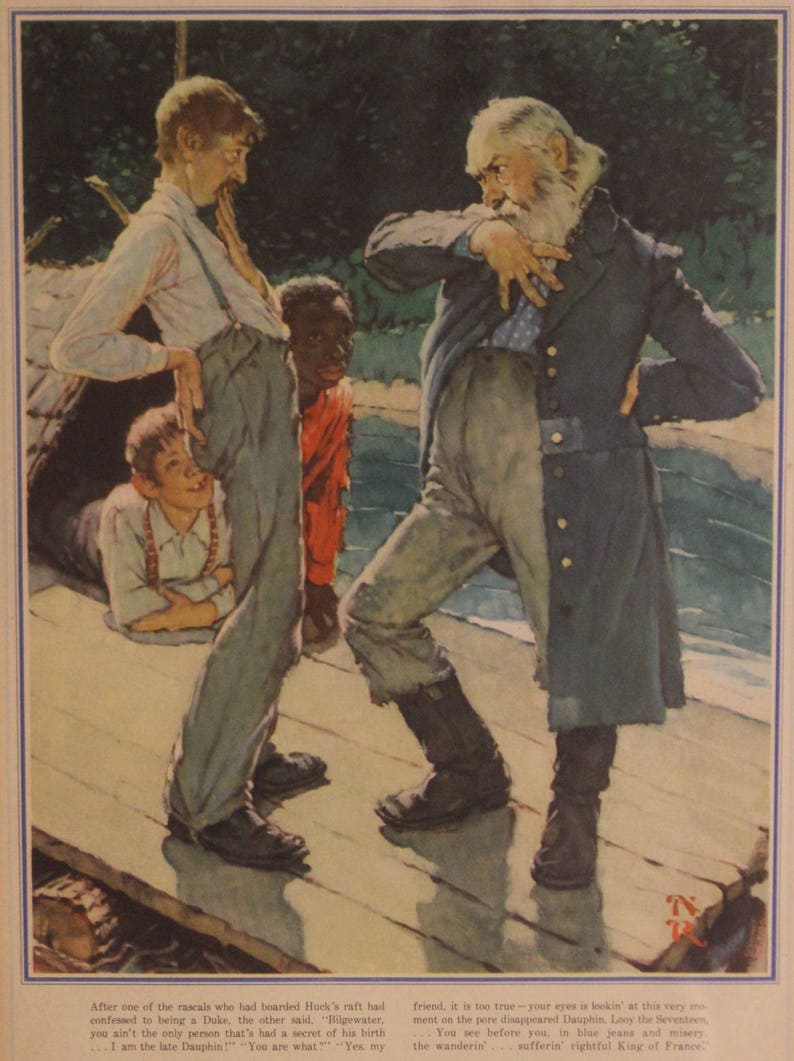
But wait! There’s more! The old man is kind of jealous here, and he sobs about his unfairness. Why, he’s the rightful King of France! The Dolphin! And now Huck and Jim have to be servants to him, too.

And so there we have two con-men who are definitely not royalty but are even conning each other.

Huckleberry Finn: The Duke and the King Norman Rockwell | Etsy

Huck and Jim’s luck is going really bad now. They just don’t fully realize it yet. But Huck does realize pretty quickly that they are “lowdown humbugs and frauds . . . I learnt that the best way to get along with his kind of people is to let them have their own way.”

That’s kind of sad, really.

Well, these two goobers take over the raft and their future.

And oh, our King is a Shakespearean actor! Oh, he butchers Will pretty awfully. He’s quite the actor, though, pretending to be a pirate who’s been saved by hearing a preacher (and making a good amount of money at it (the equivalent of $2,500). The Duke has a few plans, and also creates a fake sign for Jim, so they could claim that he’s a slave they’re returning down to New Orleans.

And then they do Hamlet. Oh, someone give me strength. You guys know this speech. Does is sound at all like you wrote about? (And he slips in some Macbeth in there.)

Then we get the disturbing incident with Boggs. Here’s what Cliffnotes has to say:

The irony of the two frauds attempting to quote Shakespeare is surpassed only by the irony of their attempt to present it to the small Arkansas village. Huck’s description of the barren town and its inhabitants reminds readers of the squalid and cruel nature of society. The men are not only cruel to defenseless animals, they are also vicious with one another as is revealed in the death of poor Boggs. Similar to Twain’s use of the Mississippi, the murder of Boggs is based on a real event that Twain witnessed as a young man. The incident illustrates the dangers of pride and a mob mentality, and also symbolizes human’s contempt for one another. The fact that Boggs’ earlier actions are deemed harmless further illustrates that no one in Huck’s world is immune from corruption and hatred.

The cruelty of the Boggs episode is easily recognized by Huck, as is the general squalor of the town. Huck’s reaction is noteworthy, for it contrasts sharply with the “evils” of his companion, Jim. Among the string of characters that Huck encounters — from Pap to the Grangerfords to Sherburn — Jim stands above them despite society’s condemnation.

https://www.cliffsnotes.com/literature/a/the-adventures-of-huckleberry-finn/summary-and-analysis/chapters-2123

Tomorrow’s reading will show you what happens with Sherburn.

POETRY!

I promised you a poem, but I’m giving you two! Both from Robert Frost, America’s foremost poet of the 20th Century, and both frequently misunderstood. For this assignment I want you to READ BOTH, then choose ONE to WRITE UP for me. Create good, solid paragraphs detailing what you find in your chosen poem. Follow SLAM–Structure, Language, Affect, Meaning–and share with me.

READING ASSIGNMENT: Huck Finn, chapters 22-27

READING QUESTIONS:

  • 1. Why did the people return to the show?
  • 2. What do you think is the point of the incident of the shooting of Boggs?
  • 3. Why do you think we hear about Jim’s daughter “‘Lizabeth”?
  • 4.  Where did the king and duke get their plan about being the Wilks brothers?
  • 5.  How do the king and duke get the money?
  • 6.  Why does Huck steal the money from the mattress?
  • 7.  Why doesn’t Huck’s conscience bother him when he lies so much?

POETRY ANALYSIS–Robert Frost’s two poems–you choose one. This write-up will be due THURSDAY, April 2.

Here’s my analyses of BOTH poems:

March 30, 2020 (MONDAY)

Huck Finn Chapters 15-17

Huck plays a trick on Jim which backfires on him. Then Huck realizes he needs to apologize, and here’s something significant: “It was fifteen minutes before I could work myself up to go and humble myself to a slave; but I done it, and I warn’t ever sorry for it afterward neither.”

Huck is realizing that society has certain rules, but those rules aren’t necessarily “right.” For example, no white person would ever “stoop so low” as to apologize to a slave, but Huck realizes that is what’s required, because Jim is his friend.

This is one of many times when Huck will do something counter to society, and not feel sorry about it, because he doesn’t realize it, but he has a stronger moral sense of right and wrong than anyone else around him.

That conscience causes him problems when he thinks about if he did the right thing by traveling with Jim, who did something very wrong to Miss Watson who never did anything wrong to him. (Never mind that slavery was morally wrong–this society had already justified that behavior, so owning slaves never is an issue they debate in their minds anymore.)

They’re trying to reach Cairo, where they can take another river up to reach freedom for Jim. On the map below, you can see where the Ohio river meets the Mississippi. The shaded states are free ones, and if they can see where Cairo is, turn up that river, they might be free.


Then Huck hears why Jim wants to be free: he wants to buy his wife, then their two children, unless he couldn’t get them, then he’d find someone to steal them. Huck struggles with this concept–children that “belong” to another man–how could Jim think this way? The nerve, wanting his own family!

Until the runaway slave hunters come looking for him. Then Huck begins to think differently and comes up with yet another good story to get them to back off their raft–his “father” has COVID-19! I mean, smallpox! Well, naturally they’ll stay away from Huck and whoever else is on there.

And they even give Huck some money–$20 which is about $600: generous! (And little do they know they gave this money to a runaway slave. Ha.)

Of the incident Huck says, “I knowed very well I had done wrong, and I see it warn’t no use for me to try to learn to do right” especially when he thinks about doing the “right” thing and knowing it would make him feel awful if he’d turned in Jim.

GUYS! THEY MADE A MOVIE! Way back in the 1990s, and I can’t find a good version to share with all of you, but I did find some scenes (this is how I spend my Saturday nights. I can’t even blame it on the virus. My life really is this dull.).
Here’s this movie’s version of the scene above:

(In case you’re wondering, that a young Elijah Wood at Huck. Aka “Frodo”)

He’s warring with himself about the morally right thing vs. society’s “right thing.” Ideally, they’d be the same, but they aren’t.

And then they have all kinds of bad luck from that rattlesnake skin. They lose the canoe, and then they lose their raft. They lose everything.

Huck makes it to shore and wanders off to meet the Grangerfords (he’s leaving the freedom of the river, and even assumes a different name to be able to cope with society again). The Grangerfords seem like a nice family, except for the ghoulish drawings made by the daughter who could have been Emily Dickinson’s twin artist (had anyone at the time known about Emily Dickinson–she was writing, but anonymously).

Once again Huck is struck by the fantods (best word in the world) from this girl, who he says, “I reckoned with her disposition she was having a better time in the graveyard.” Her last drawing before she died had so many different arms in different positions that it looks “spidery” to him (spiders again!).

So this is where Huck is staying for a little while, but the Grangerfords aren’t entirely nice as they seem. Remember Romeo and Juliet? Keep that plot in mind as you read the next chapters!

Here are some good insights I stole some years ago and now can’t find the citation for:

When Huck acts like Tom Sawyer, trouble follows, but when he acts like himself—when he seeks to interpret and react to experience in a practical manner—things generally turn out fine.

In a number of instances in the novel, Jim protests when Huck formulates a foolish plan, but eventually gives in to the boy. Twain never explicitly explains Jim’s reasoning, but the implication is always there that Jim’s caution stems from his constant fear of being caught and returned to his former owner. After all, Huck, though a child, is a free, white child who could turn in Jim at any time and collect a large reward for doing so. Although this idea seems never to cross Huck’s mind, it lurks beneath the surface of Jim and Huck’s interactions and reminds us of the constant fear Jim lives with as an escaped slave.

READING ASSIGNMENT: Huck Finn Chapters 18-21 (And you’ll run into some Hamlet again. Well, sort of. You’ll see. You’ll weep–or laugh, who knows.)

READING QUESTIONS:

  • 1.  Why do you think Twain include this adventure with the Grangerfords?
  • 2. How do Jim and Huck meet the king and duke?
  • 3.  Does Huck believe their story?
  • 4.  Give two examples of the “cleverness” of the king and duke.

(Tomorrow we’ll do another poem, this time by Robert Frost.)

March 27, 2020

Huck Finn chapters 12-14

If you’re wondering what kind of raft (also called a skiff) Huck and Jim are using, here’s an idea (complete with their wigwam to keep them dry in the rain):

What do you think about Huck’s “borrowing” that he learned from Pap? Easy to justify any kind of behavior if you couch it in terms of what you “intended” to do later.

They find a steamboat wreck–the Walter Scott–and decide to investigate it. Perhaps it looked something like this:

Jim is cautious and hesitant, because he’s got the most to lose. Huck is more adventurous and not realizing what danger he could be putting Jim in. Now, there’s a SECOND Jim who is part of these thieves, so don’t get OUR JIM mixed with the BAD JIM whose last name is Turner. (Why Twain couldn’t have thought of a different name, I don’t know.) The gang comes up with a way to “kill” Bad Jim without really being responsible for it.

Think about this incident: Twain is showing how people justify their bad behavior and make it appear it’s someone else’s fault, not their own.

Huck has an idea–get rid of the gang’s boat so they can’t leave Bad Jim to drown on the steamboat when it goes under, and send the sheriff to arrest them all, saving Bad Jim Turner’s life.

Think about Huck’s character here, especially when he considers that he doesn’t want to leave even murderers in such a bad position, because who knows–Huck might someday be a murderer himself. Consider his sense of morality: even if these guys are horrible, he still doesn’t want to be the means of them suffering. How does that contrast with the “white trash” attitude of everyone else around him? It seems like Twain is suggesting that Huck and Jim are the only really moral people around.

Clever Huck then comes up with a way to send “help” to the steamboat and take care of the murderers properly. And then he and GOOD Jim get to enjoy the spoils of their evening.

(Seegars, by the way, are cigars.)

The story about King Solomon–the REAL story is that he was very wise, and to demonstrate it, the Old Testament tells of a story about two women who lived together (presumably harlots) who both had babies. One accidentally rolled over on her baby, smothering it, so she swapped her dead baby with the other harlot’s baby, so when they woke up, she had a live baby and claimed it was hers. Naturally the mother of the live baby was furious that the other woman stole her baby, and they took the case to King Solomon. What Jim gets wrong is how Solomon determines the real mother.

Solomon’s solution, which sounds ghastly but he was never going to go through with it, was to take the living baby and cut it in half, giving one half to each mother. Of course the REAL mother would do anything to protect the life of her living baby, so she said the other woman who stole it could keep it. Whereas the woman whose baby died was perfectly fine with her “friend’s” baby also dying. King Solomon then gave the baby to the rightful mother, because he could determine definitively who she was.

But poor Jim misses the point of the story. He does have a fascination with kings, it seems, and when they mention the dolphin, they’re referring to the Dauphin, who was the son of the French King Louis the XVI. Of course, they don’t understand the term “Dauphin” so they call him the dolphin.

And also Jim doesn’t understand French. (Sorry, Tiphaine.)

IMPORTANT SYMBOL

Huck and Jim are now on the river, which symbolizes freedom. They are their own family, their own set of rules, their own masters (no one owns Jim on the river). The banks of the river, however, represent society and its expectations, rules, and constraints. Watch what happens in the next several chapters when Huck and Finn have to go ashore, and then how their lives are when they remain on the river.

ANOTHER POEM TO READ AND WRITE ABOUT!

I have to say I love the people on the AP English Facebook page. I feel like I have 6,000 new friends, and we all feel the same way–THIS ISOLATION FROM OUR STUDENTS STINKS!

Anyway, someone in the AP teachers page posted this:

Image may contain: 1 person, text

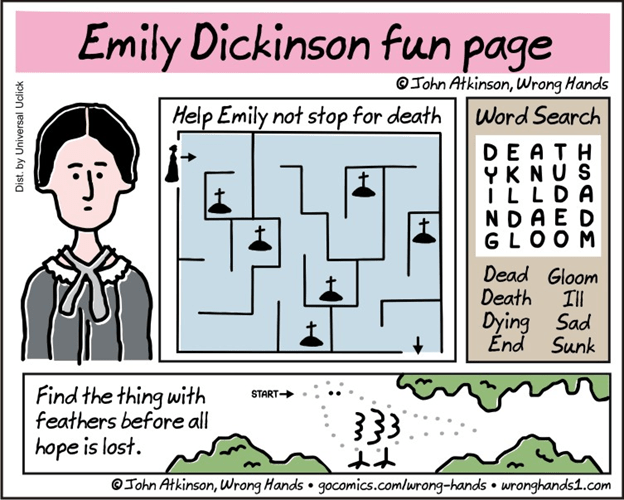
We’re going to be doing some more of Emily Dickinson, and here’s a fun page for you to do:

Getting a feel for her style? She had a thing about death, and not that she was terrified of it, or morbid, but sincerely intrigued, it seems.

We’re going to look at her (probably) most famous poem, “Because I could not stop for Death” As with last time, I want you to READ it, MARK IT UP, then WRITE about it–but you can wait with your write-up until I post my Youtube video explanation of what I see in the poem. Then see what we have in common, what you discovered that I didn’t mention, etc. HERE IT IS!

As you read the poem follow SLAM–Structure, Language, Affect, and Meaning. Here are a few items to notice and ask, Why did she do this?

  • What words are capitalized?
  • What purpose do the dashes serve?
  • Does she use alliteration? Where? What does it do?
  • What’s going on with time in the poem?
  • What does all of this mean?

READING HOMEWORK: Huck Finn chaps. 15-17

READING QUESTIONS:

  • 1.  What trick does Huck play on Jim?
  • 2.  Why doesn’t Huck turn in Jim?
  • 3.  Why don’t the slave hunters get Jim?
  • 4.  Explain the differences between Huck and the slave hunters.
  • 5.  What is the bad luck in Chapter 16?
  • 6.  How does Huck get to the Grangerfords?

POEM ANALYSIS: Emily Dickinson’s “Because I could not stop for Death”. You may use ideas from my YouTube annotation, if you wish. Create a one-page analysis–in PARAGRAPH FORM–of what you see happening in this poem.