March 26, 2020

Huck Finn, chapters 8-11

Let’s look at some of the language in here. We could look at any page, but I chose one from chapter 9. This is a great description, and look at the sentence length here as he describes a thunderstorm:

We put all the other things handy at the back of the cavern. Pretty soon it darkened up, and begun to thunder and lighten; so the birds was right about it. Directly it begun to rain, and it rained like all fury, too, and I never see the wind blow so. It was one of these regular summer storms. It would get so dark that it looked all blue-black outside, and lovely; and the rain would thrash along by so thick that the trees off a little ways looked dim and spider-webby; and here would come a blast of wind that would bend the trees down and turn up the pale underside of the leaves; and then a perfect ripper of a gust would follow along and set the branches to tossing their arms as if they was just wild; and next, when it was just about the bluest and blackest—FST! it was as bright as glory, and you’d have a little glimpse of tree-tops a-plunging about away off yonder in the storm, hundreds of yards further than you could see before; dark as sin again in a second, and now you’d hear the thunder let go with an awful crash, and then go rumbling, grumbling, tumbling, down the sky towards the under side of the world, like rolling empty barrels down stairs—where it’s long stairs and they bounce a good deal, you know.

Why such long sentences? Probably to keep the feel of the storm as one great emotion?

I love the description of the thunder, like empty barrels rolling down stairs . . . and they keep going. This sounds and feels like a young teenager, and immediately everyone knows exactly what he’s feeling. The voice here really works.

What’s your mood when you read these lines? Is it frightening? (I don’t think so.) It would get so dark that it looked all blue-black outside, and lovely;

The language is almost poetic: thunder let go with an awful crash, and then go rumbling, grumbling, tumbling,

A student last year (Matias) notice that there’s a lot of subtle spider images in this book. Here’s one of them: the trees off a little ways looked dim and spider-webby.

Look at this fun personification: then a perfect ripper of a gust would follow along and set the branches to tossing their arms as if they was just wild;

Hearing these words come from an adult protagonist would be odd. But from a kid? It just works so well!

Here’s another collection of great lines from Huck and Jim:

  • “There’s something in it when the widow or the parson prays, but it don’t work for me.” (This makes me so sad for him! Still, he got his bread, right?)
  • “saw a man . . . It most gave me the fantods.” (I have NO idea what fantods are, but we really should be using that word more.)
  • Jim said bees wouldn’t sting idiots; but I didn’t believe that, because I had tried them lots of times myself, and they wouldn’t sting me. (He doesn’t even realize he’s not an idiot.)
  • “Doan’ hurt me—don’t! I hain’t ever done no harm to a ghos’. I alwuz liked dead people, en done all I could for ’em. You go en git in de river agin, whah you b’longs, en doan’ do nuffn to Ole Jim, ’at ’uz awluz yo’ fren’.” (I just love poor Jim–“Hey, I always liked dead people, so just go away or something, please.”)
  • They’re looking for signs, especially bad one. Why would you care about good ones? “Ef you’s got hairy arms en a hairy breas’, it’s a sign dat you’s agwyne to be rich.” (No, it’s not. I’m still not rich.)
  • Yes; en I’s rich now, come to look at it. I owns mysef, en I’s wuth eight hund’d dollars. I wisht I had de money, I wouldn’ want no mo’.” (Wow–think about that: he owns himself, and he owns a lot then.)

Then there are some sections that just crack me up, like this:

[When they’ve found the wooden leg.] The straps was broke off of it, but, barring that, it was a good enough leg, though it was too long for me and not long enough for Jim, and we couldn’t find the other one, though we hunted all around.

WHY WOULD SOMEONE HAVE TWO WOODEN LEGS?!

But they also get some good supplies from that house, so that’s all right. Mighty convenient, an entire house coming down the river. But if you looked at the video I posted yesterday, and consider that houses in the 1800s weren’t secured to their foundations very well, it’s easy to see how a whole house on the banks when it’s flooding would go downstream.

Bad luck: Notice how they’re always waiting for it? It may be delayed for days or even years, but it’s coming! Superstitious people who don’t understand cause and effect (because they aren’t very well educated) put a lot of “faith” in luck, mostly bad. Because they can’t read circumstances, or have limited knowledge as to how events unfold, they can’t predict what bad thing may happen. To them, it’s all mysterious–or bad luck.

I’d always felt that looking at a new moon over your left shoulder was one of the most careless and foolish things a person could do. Old Hank Bunker did it once and bragged about it. In less than two years, he got so drunk that he fell off the shot-tower.

But seriously, sticking a rattle snake in someone’s bed? That’s just stupid, Huck! And eventually he figures that out.

Huck also learns how to be a girl, kind of. Try this at home: Have someone toss you something that you catch with your lap. Or try threading a needle. Hmm, I don’t think these “tests” are applicable anymore.

At the end of this reading, Huck and Jim are leaving the island ahead of people looking for Jim. Now begins their grand adventure on the river–together.

Here’s some great insights (I think from Spark Notes?)

From this point in the novel forward, their fates are linked. Jim has had no more say in his own fate as an adult than Huck has had as a child. Both in peril, Huck and Jim have had to break with society. Freed from the hypocrisy and injustice of society, they find themselves in what seems a paradise, smoking a pipe, watching the river, and feasting on catfish and wild berries.

 Huck and Jim are reminded that no location is safe for them.

These two incidents also flesh out some important aspects of the relationship between Huck and Jim. In the episode with the rattlesnake, Huck acts like a child, and Jim gets hurt. In both incidents, Jim uses his knowledge to benefit both of them but also seeks to protect Huck: he refuses to let Huck see the body in the floating house. Jim is an intelligent and caring adult who has escaped out of love for his family—and he displays this same caring aspect toward Huck here. While Huck’s motives are equally sound, he is still a child and frequently behaves like one. In a sense, Jim and Huck together make up a sort of alternative family in an alternative place, apart from the society that has only harmed them up to this point.

Mrs. Loftus and her husband are only too happy to profit from capturing Jim, and her husband plans to bring a gun to hunt Jim like an animal. Mrs. Loftus makes a clear distinction between Huck, who tells her he has run away from a mean farmer, and Jim, who has done essentially the same thing by running away from an owner who is considering selling him.

Whereas Mrs. Loftus and the rest of white society differentiate between an abused runaway slave and an abused runaway boy, Huck does not. Huck and Jim’s raft becomes a sort of haven of brotherhood and equality, as both find refuge and peace from a society that has treated them poorly. 

Some money numbers are tossed around–here’s what they mean today:

  • Jim’s worth $800=22,800
  • Pap reward $200=5,700
  • Jim’s reward $300=8,600

READING ASSIGNMENT: Chaps. 12-14

WRITING ASSIGNMENT:

  • 1.  Why do Huck and Jim begin their journey down the Mississippi?
  • 2.  Why do Huck and Jim board the Walter Scott?
  • 3.  Why does Huck want to save Jim Turner?
  • 4.  How does Huck send help to the Walter Scott?
  • 5.  What do we learn about Jim from his talking about “King Sollermun”?

(I’ll assign another poem tomorrow. Just read today and do the questions above.)

March 25, 2020

Huck Finn chapters 4-7

There’s spring flooding on the Mississippi River in Huck Finn–this occurs frequently–and if you want to see some footage of what a massive flood looks like, here’s some coverage from the big 2011 floods.

We see just how clever Huck can be: he realizes his father is looking for him–or rather, for his money–and Huck sets up a way so that it’s no longer in his possession.

We see more examples of superstition–“education” for the uneducated (and it makes me wonder what kinds of superstitions may rise up from this quarantine situation; I’m already seeing a few about “miracle cures”). Frankly, I’m not sure what kind of learning will come from a hairball, and I hope to never find out. I hope to never encounter a hairball like Jim’s! But, well, hairballs.

(I mean, how big was the cat that coughed that up? Oh wait, it’s from an ox. Somehow it just got worse.)

You first encounter Jim’s dialect, which may cause a few of you to stumble.

  • gwyne=going to
  • doan=don’t
  • spec=expect
  • ag’in=again
  • by en by=by and by, eventually
  • fust=first
  • kin=can
  • fum=from
  • resk=risk

It really does help to read it out loud to yourself, because hearing the words suddenly makes sense what he’s saying. You’ll get the hang of his dialect pretty soon, though.

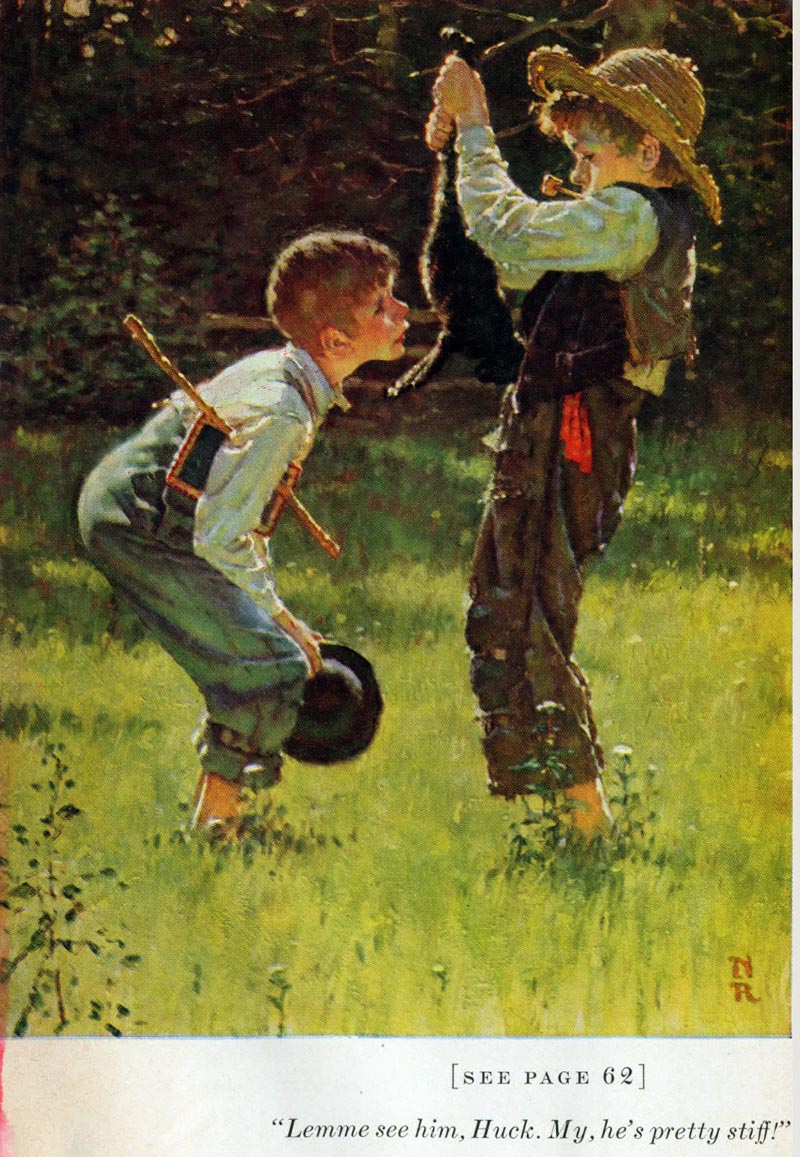
Huck’s father, Pap. Ooh, a lovely man. Yuck. Here’s an illustration from a book. Pretty much sums him up.

Image result for huck finn father

How does he treat his son? Horribly! “Drop out of school. Don’t wear nice clothes. You’re showing us all up, reading and knowing numbers. Sleeping in a bed . . . Sheesh, trying to make your family look bad?” Umm, Pap? You make yourself look bad all on your own. Taking your son’s last dollar so you can go drinking? Nice Dad, really nice.

Why do you think his father is so opposed to all of this “sivilization”? To me, he sounds afraid. He may also be jealous, or feel like his son is proving that he could have been something more, something better, but he was too lazy and selfish to become such.

I read a quote once, “All good parents want their children to become better than they are.” If this is true, then clearly Pap is not a good parent.

What do you think of the incident with the new judge, who’s sure he can reform Pap and turn him good? I think all of us know of at least one similar case, where someone is “playing” at being good just to get what they want, then immediately fall off the wagon. They never intended to improve, to give up their addiction, or stick with a job, or become better. I guess the main lesson to take away from this is, We’ve been dealing with the same problems for many years now. Nothing’s new.

I like this insight from Spark Notes:

Twain makes a number of comments on the society of his time and its attempts at reform. We see a number of well-meaning individuals who engage in foolish, even cruel behavior. The new judge in town refuses to give custody of Huck to Judge Thatcher and the Widow, despite Pap’s history of neglect and abuse. This poorly informed decision not only makes us question the wisdom and morality of these public figures but also resonates with the plight of slaves in Southern society at the time. The new judge in town returns Huck to Pap because he privileges Pap’s “rights” over Huck’s welfare—just as slaves, because they were considered property, were regularly returned to their legal owners, no matter how badly these owners abused them. Twain also takes the opportunity to mock the bleeding-heart do-gooders of the temperance, or anti-alcohol, movement: the judge is clearly naïve, misguided, and blind to the larger evils around him, and the weeping and moralizing that goes on in his home is grating, to say the least.

Huck is at the center of countless failures and breakdowns in the society around him, yet he maintains his characteristic resilience. Indeed, Huck’s family, the legal system, and the community all fail to protect him or to provide a set of beliefs and values that are consistent and satisfying to him. Huck’s wrongful imprisonment elicits sympathy and concern on our part, even though this imprisonment does not seem to distress Huck in the least. Sadly, Huck is so used to social abuses by this point in his life that he has no reason to prefer one set of abuses over the other.

Finally Huck’s Pap kidnaps him, takes him to a secluded cabin, and locks him up. (No, none of you are locked up, but you can feel a little bit for him right now, can’t you?) He enjoys it for a while, his clothes get all ratty, he picks up swearing again, and everything’s great . . . except that his dad is beating him, with wood planks. Then he gets locked up in the cabin for three days straight. Not so fun anymore.

Pap has lovely views about people as well, especially freed slaves being allowed to vote. We read Pap’s ranting and wince at how awful he sounds, but at Twain’s time there were still a LOT of people who felt the same way, 20 years after slaves had been freed. “I’ll never vote again!” Oh, good. We all feel better about that, Pap.

Here’s more insight, again from Spark Notes:

Pap, the embodiment of pure evil, is one of Twain’s most memorable characters. Because we have no background information to explain his present state, his role is primarily symbolic. The deathly pallor of his skin, which is nauseating to Huck, makes Pap emblematic of whiteness. Unfortunately, Pap represents the worst of white society: he is illiterate, ignorant, violent, and profoundly racist.

The mixed-race man who visits the town contrasts Pap in every way: he is a clean-cut, knowledgeable, and seemingly politically conscious professor. In establishing the contrast between Pap and the mixed-race man, Twain overturns traditional symbolism of his time and implies that whiteness, not blackness, is associated with evil.

Clearly Pap drinks waaaay too much, goes crazy one night, tries to kill Huck mistaking him for the Angel of Death, and Huck realizes he MUST get away from him.

Here’s where we see the flooding river, and all kinds of stuff floating down it. Huck finds a canoe worth $10 which would be about $260 now, and Pap collects some logs that he’s going to sell.

They’re catching stuff floating down the river, and Huck says that any other man would have waited out the day to see what else comes in, but not Pap. He heads to town to sell the logs without seeing what else he could get. What does that tell us about Pap’s character?

Now, Huck hatches his plan to escape, and it’s a pretty good one. (This is where you can “hear” Mark Twain writing, instead of Huck Finn planning, because I don’t know of another 13-year-old who could come up with such a plan.) He fakes his own death, with blood and his own hair on the hatchet, creates cover stories and false leads to throw people off, and has even cut out part of the wall so he can go in and out. He’s got a canoe, so he’s free to head down the mighty Mississippi, down to Jackson’s Island.

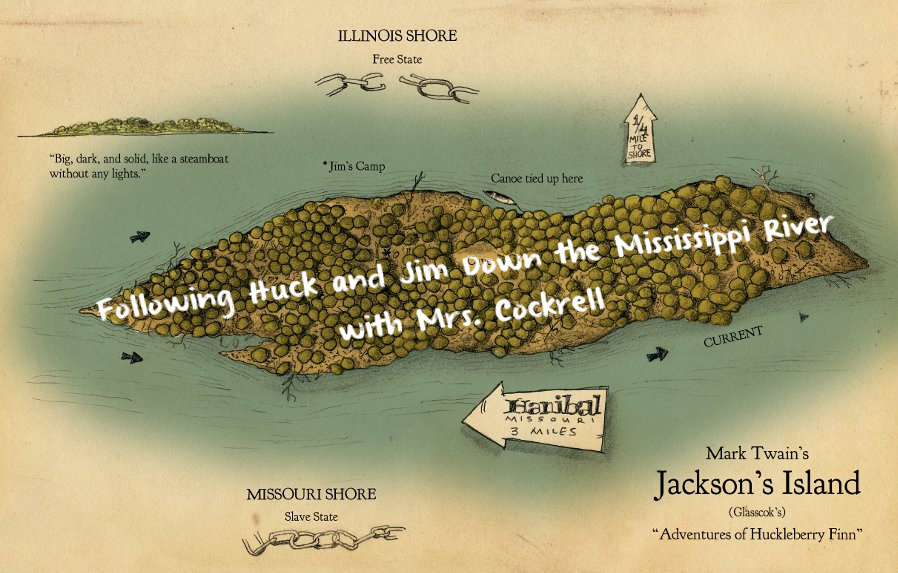
Here’s a great image I stole from some teacher named Mrs. Cockrell. We all thank her.

The Adventures of Huckleberry Finn with Mrs. Cockrell

So Huck’s free! From Pap AND from sivilization.

I love some of the language Twain uses:

“Everything was dead quiet, and it look late, and smelt late. You know what I mean–I don’t know the words to put it in.”

Anyone else experience that? “Smelling” the time of day or night? I can always smell spring coming. I’ve been “smelling” it for the past week or so, despite the snow on Tuesday.

Little tidbits like that are so fun in this book.

Now, let’s talk a little about Emily Dickinson and the poem you read for today: “Hope is a thing with feathers” And guess what? After only about seven hours of trying to figure out tech and recording and uploads and what have you, I have created a VIDEO ANNOTATING THIS POEM! (Seriously–7 hours of labor for 12 minutes. Guys, you better love this. Or don’t, because seriously, it’s sad. Anyway my first ever YouTube video. Oh, how much I’m learning . . .)

I hope you marked it up. Now you’re going to have a little writing assignment.

Writing Assignment: “Hope is a thing with feathers”

On a Google Doc, explain to me in a paragraph or two what this poem is about. In your own words, explain what Dickinson wants us to understand from this poem. What is it about, why this metaphor, etc. Tell me anything and everything you got from this. And why do you think she wrote it the way that she did? (Does she use any literary devices, language devices, etc.–why?)

Huck Finn Reading and Questions Assignment: Read chapters 8-11 and complete these questions on your log:

  • Chapters 8-11
  • 1.  What purpose(s) does Huck’s death serve?
  • 2.  How does Huck meet Jim on Jackson’s Island?  Why is Jim there?
  • 3.  What is in the two-story house that floats by?
  • 4.  How are the townspeople superstitious? Jim? Huck?  Give examples.
  • 5.  Compare/contrast Huck & Jim.
  • 6.  Why does Huck dress as a girl to go ashore? Why does he go? What does he find out?
  • 7.  How do you know Huck and Jim are friends by the end of Chapter 11?

March 24, 2020

Huck Finn, Chapters 1-3

LESSON

Welcome to the world of Huck Finn! Where a teenage boy, uneducated and with no real family of his own, has a small fortune ($6,000 would be equivalent to about $165,000, and the $1 each boy gets per day would be the same as $27 today). And he can’t bear to be cooped up inside. (Can any of you relate? To the cooped up part, not the making bank part.) He can’t bear being “sivilized,” and what that means will become a big part of this novel.

And yes, the misspelling are intentional. It’s part of Twain’s characterization of Huck, and also, I think, his way of saying “Do we really know what this word means?”

First, lets talk about some important literary devices at work here. This is the first real novel we’re reading, since we’ve been doing plays, so we have elements we haven’t discussed yet.

Literary Device–NARRATOR!

Let’s look at Point of View (narrator): our narrator is 13-year-old Huck Finn, and everything we see will be through his eyes. And his views are definitely different. He sees things almost opposite of everyone. For example, he says that the Widow Douglas calls him “a poor lost lamb” but she “never meant no harm by it.” Now, we’d see calling someone a lost lamb as a term of endearment, of worry and concern, but apparently Huck thinks it’s some kind of insult.

Just these first few chapters gives us a big insight into our narrator, and that we’re going to see the south, and the world, through very different eyes!

Here’s something else we need to ask—is this narrator reliable? Meaning, can we trust Huck to show us everything accurately, or are his biases and ideas going to taint just about everything we see?

And more importantly—is that good or bad? (Hint: it’s not necessarily bad.)

Because we have a first person narrator, and everything is going to be from his point of view, we need to sometimes step back from him and consider what he’s seeing and experiencing, and try to interpret it for ourselves. Also understanding that Huck is still young–only about 13–he’s going to understand things differently than adults would.

And that’s exactly what Mark Twain was hoping we’d notice: adults often “justify” attitudes and behaviors (ever heard the story of The Emperor’s New Clothes?). But children quite often see around the justification and excuses, and see only what’s directly in front of them, which, Twain was trying to say, was often more accurate and truthful than what society was trying to hold up.

So we’re going to see a sometimes painfully accurate point of view, first person narrative (pretend I’m writing all of this up on the board) when we read.

Just look at his understanding of the “good place” and the “bad place” and why he’s prefer to be in the “bad place.” Huck is deadly honest–he doesn’t have any craft or guile in him–and he calls it as he sees it.

Why would Twain create a character like this? Because through Huck, Twain gets to say everything he wants to, and all the blame falls on “young, innocent, uneducated Huck.” Never mind that an older, crotchety, well-educated man is actually saying all these things. Our author is hiding behind his narrator, and that gives him immense freedom! Twain was very clever, knowing he could never point a finger at a hypocritical society, but that an innocent boy certainly could.

Now, Huck Finn began as a character in Twain’s earlier book, Tom Sawyer, which has a different tone and purpose. However, we see Tom Sawyer here in these early chapters and, as a mom of five boys, and I can tell you I’d NEVER want a son like Tom!

(Huck–sure. I’d take him. He’s grown on me. But Tom? I’d send him off to a residential treatment center for clinically insane because this boy is MESSED UP!)

Tom wants to create a club! And what a fun club it is! With blood oaths! So they can rob and murder! (All in good fun, mind you. Uh, no. Get this kid LOCKED UP!)

Huck has some real horse sense–for example, he knows his father isn’t the dead body found floating in the river, because it should be face down, not face up which is how a woman would float. Huck, you’ll soon discover, is very clever and can get out of a number of scrapes because he’s aware of his surroundings and knows how to read a situation. (Unlike Tom who thinks it’s a great idea to raid a Sunday School luncheon pretending they’re Arabs with camels and elephants. I mean, WHERE ARE THIS BOY’S PARENTS?! Can’t they tell he is three legs short of a full horse?)

But perhaps it’s telling that Tom says of Huck, “It ain’t no use talking to you, Huck Finn. You don’t seem to know anything, somehow–perfect saphead.” This, coming from the sappiest-head kid ever created in literature. If Tom doesn’t approve of you, then you MUST be good! (Can you tell I really don’t like Tom? He’s that boy your mom warns you about. But Huck doesn’t have a mom–she’s died, and that’s why two old women have taken him in to sivilize him.)

Huck is naturally cynical, as you’ll soon discover. A realistic philosopher, if you will, questioning everything (again, Twain hiding behind his narrator). Huck also is suspicious of “romantic nature.” Tom is all about “romantic nature,” as you can tell by his elaborate oaths and doing things “by the book.” There were many novels in the 1800s which were over-the-top romantic and adventurous, and it often feels in this book that Twain is taking digs at those, trying to show that the romantic view is distorted and causes more problems than its worth.

But while Huck is clever and cynical, he’s also uneducated and very, very superstitious, as is Jim. We see him here after Tom and Huck lead him to believe that he’s been captured by witches, and soon that tale spins wildly out of control for Jim, although it makes him quite popular for a time among the other slaves. We’re going to see much more of Jim later, but what are your first impressions of him? Keep those in mind as we read.

Literary Device–Diction!

So now you’ve seen the very different language style of Twain. He writes in a few diction styles, which takes a great ear to translate.

Why bother doing this? Remember that diction helps establish the TONE--the attitude of the author toward the writing. What kind of tone do we have here? A very relaxed, colloquial tone. You can really hear a kid talking here, rambling even, going all over the place as he tells his story. Some of the sentences are very long, grammar mistakes abound, some spelling is questionable, and all of it translates to creating a laid-back, child-like, almost carefree feel to the novel=the novel’s VOICE (personality, etc. You can’t tell, but I’m pointing to that definition on the whiteboard.).

Twain was the first to do this–no one had attempted to write an entire novel in “slang” like this before, and his boldness inspired thousands of authors after him to experiment with language, voice, and tone.

READING ASSIGNMENT: Read Chapters 4-7

WATCHING ASSIGNMENT: Yes, I know this is new–just slipped this in here. Watch a few minutes of this video which takes you down the Mississippi River. The next few chapters are going to get us to the river, and it helps to have an understanding of just how immense it is:

This map is also helpful for the rest of the book:

WRITING ASSIGNMENT: Continue your Huck-on-a-Log by answering these questions. Write COMPLETE SENTENCES, and give 2-4 sentences for each answer:

  • 1. Why did Huck give his money to Judge Thatcher?
  • 2.  Describe Pap Finn.  What kind of a person is he?
  • 3.  What is Huck’s attitude towards his father?
  • 4.  Why does Pap yell at Huck for becoming civilized? Is he right?
  • 5.  What was Huck’s plan of escape from his father?
  • 6.  How do you know that material things don’t matter to Huck?

AND A POEM!

We’re going to do poetry mixed in here, and Emily Dickinson is a great place to start. Read “Hope is a Thing with Feathers” and spend just 10 minutes annotating it. You do NOT have to write up anything about it–yet. We’ll discuss it tomorrow. But read it, write it (either online some way, or print it and mark it up at home) and watch for tomorrow’s lesson.

March 23, 2020

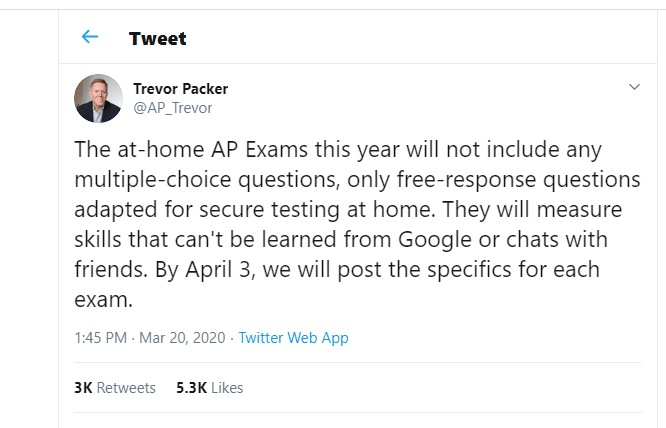
UPDATE ABOUT AP TESTING! Straight from a head honcho at AP:

What does this mean? We will have only ONE essay to write, online, AT HOME. These are the same essays I’ve been making you hand write, but NO MORE! You WILL be able to type this! (So all of our hand writing practice is for naught, naturally.)

There will also be NO multiple choice questions (which many of you seemed to loathe anyway).

What the essay will be about–over a poem, or over prose, or an open-ended question about a book–we do NOT KNOW YET! April 3 is the magical date, and right now that feels so far away.

So until I know more, we’ll be practicing writing essays for poems and prose, which we haven’t done too much of yet. Your last batches of Hamlet essays were–I’m very pleased to report–pretty darn good. You’re getting better at succinctly stating the thesis, providing evidence (as much as possible) and summing it all up.

So the next two weeks, we’ll be reading The Adventures of Huckleberry Finn and analyzing poetry. Once I hear what’s happening with the AP Exam, we’ll refocus efforts toward that.

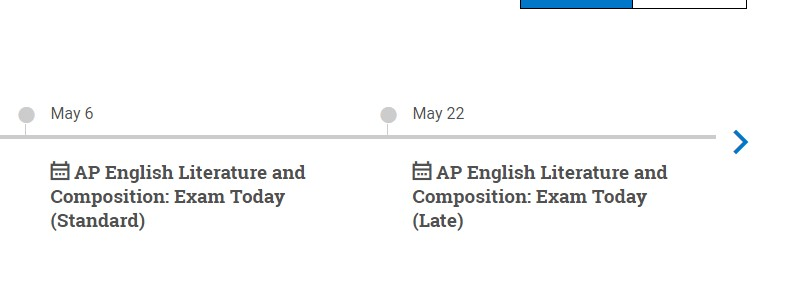
It looks like we have TWO test dates now. I copied this from the College Board website Saturday morning:

What I think this means is that if you want to take the test as previously planned–Wednesday, May 6–you may do so. If you want a few weeks more of practice, to take it on Friday, May 22, you may. I imagine they’ll be two very different tests, so you won’t be able to ask your buddies who took it earlier what it was about. Nor do I know yet if an entire school has to take it at the same date or not. I imagine all will be clarified by April 3.

That’s how things stand on Saturday, March 21. By now we know that everything may be different again by Sunday, and again by Monday. What a heckuva year this week has been . . . So onward! To new adventures!

The Adventures of Huckleberry Finn! And we’re having Adventures in Online Learning!

Friends, it’s come to this: the dream of all introverts. School at home. We’ll do our best.

But first, a high school friend who took AP Lit with me sent me this, for all of you:

You’re next assignment is to write a Shakespearean Play, due Friday. No? Fine. We’ll read instead.

I’ll try to set up each day in THREE PARTS:

  1. LESSON
  2. READING ASSIGNMENT
  3. WRITING ASSIGNMENT

Knowing me, I’ll forget this line up, but for today it feels organized.

PROCEDURE:

I will try to post each lesson the night before, then I’ll be available to chat with you online during “Class Time.”

Here’s WA’s official schedule:

  • PERIOD 1   10:00 to 10:30
  • PERIOD 2    11:00 to 11:30
  • LUNCH        11:30 to 12:30
  • PERIOD 3    12:30 to 1:00
  • PERIOD 4    1:30 to 2:00 

But I will be online for most of the day/evening, so you may email me, Google Chat with me, message me on Facebook, or try screaming really loud, and I’ll do my best to respond in each and every way.

LESSON:

The Adventures of Huckleberry Finn, (referred hereafter as Huck Finn) by Mark Twain, is one of the most famous and controversial books in America.

Remember the Civil War? That was in 1861-1865. This book was written 20 years after slaves have been granted freedom, in 1885, but set several years before the Civil War broke out, around the 1840s (lost yet?). Even though slaves were “freed,” things didn’t improve for blacks for many decades.

That bugged Mark Twain. He especially hated the hypocrisy he saw in America, which was most prevalent in the south. Watch this 3 minute video about America’s most famous author. He was also called the “First Celebrity” since he was the first to develop a “following.” (Think Instagram star, but he’d be InstaGramp. He even knew how to sell himself–hint, it’s a white suit.)

Notice what he was doing at age 15.

“Shoot arrows at the most powerful . . .” We should all have that motto!

The video mentions the “vernacular speech,” which is part of why this book is controversial, and also why it’s difficult to read. (Don’t worry, you can read it No Fear version here.) Twain wrote how people spoke, and when you look at the text, you’ll see that some of it can be very difficult to decipher:

“Don’t you give me none o’ your lip,” says he. “You’ve put on considerable many frills since I been away. I’ll take you down a peg before I get done with you. You’re educated, too, they say—can read and write. You think you’re better’n your father, now, don’t you, because he can’t? I’LL take it out of you. Who told you you might meddle with such hifalut’n foolishness, hey?—who told you you could?”

See? The other issue is the “n” word. It shows up a lot, because it was standard language in 1885. While the “n” word is extremely derogatory now–and we will NOT write it or use it–it was simply an accepted term 150 years ago. That does not make this book racist, as some claim it is. Quite the contrary; Mark Twain was all about fighting racism, as you will see in the reading. Be forgiving of their language use–the language wasn’t offensive when he wrote it.

If you want to hear how the slave Jim and Huck Finn would sound read out loud, I found this video clip of Bill Murray years ago reading a “deleted” chapter from Huck Finn. You don’t need to listen to all of it, but may for a minute or so, to hear the vernacular. Both Huck Finn and Jim have different ways of speaking. It’s really quite a feat to be able to write this way. Twain had an excellent ear for dialects and captured this remarkable well (START at about 1:20 and listen for a minute or so):

And Bill Murray is quite a talented actor to be able to read the dialects so well.

MAJOR THEMES in Huck Finn (according to one source)

  • Slavery: When Mark Twain wrote this book, slavery had been abolished; however, black people were still treated as second class citizens. The fact that Huck befriends Jim, a runaway slave, and saves him in the end plays on this theme.
  • Freedom: Going hand in hand with the theme of slavery is freedom. Huck wants his freedom from his father. Jim wants his freedom to be a human being and be with this family.
  • Adventure: One of the most entertaining Huckleberry Finn themes is the theme of adventure. At the beginning of The Adventures of Huckleberry Finn. Huck is tired of “playing” at adventure with Tom Sawyer. Then his pa comes back and Huck’s real adventure on a raft down the Mississippi River begins.
  • Money/Greed: The characters in this Mark Twain book, who care more about money than people and are overcome by greed, are often suffering. This theme shows the reader that money and “being civilized” is not what is important in life–friends, family, honesty, loyalty–these are the important things. Huck’s pa is a perfect example of the disastrous nature of greed.

MAJOR THEMES in Huck Finn (according to another source)

  • 1.  Man can be inhuman toward his fellow man. (morality)
  • 2.  Society’s values and laws can be in conflict with higher moral values. (hypocrisy of society)
  • 3.  People must live outside of society to be truly free. (freedom)
  • 4.  Growth of self occurs through close, honest observation of society and the individual. (maturity)
  • 5.  Gullible people are partially responsible for their own deception. (superstition, ignorance)

ALL of the above plays in this book which is NOT a children’s book (as some people who have never bothered to read it think it is) but it a complex analysis of society and ultimately asks the question, When and how should you rebel against what “society” is telling you to do?

Here’s a difficult yet telling modern day example of this theme: Would you really have spoken out against slavery? (You don’t have to answer that question, but think about this scenario.)

By Robert P. George

Something tells me it’s time to re-post this comment:

Undergraduates say the darndest things. When discussing the history of racial injustice, I frequently ask them what their position on slavery would have been had they been white and living in the South before abolition. Guess what? They all would have been abolitionists! They all would have bravely spoken out against slavery, and worked tirelessly in the cause of freeing those enslaved. Isn’t that special? Bless their hearts.

Of course, it is complete nonsense. Only the tiniest fraction of them, or of any of us, would have spoken up against slavery or lifted a finger to free the slaves. Most of them—and us—would simply have gone along. Many would have supported the slave system and, if it was in their interest, participated in it as buyers and owners or sellers of slaves.

So I respond to the students’ assurances that they would have been vocal opponents of slavery by saying that I will credit their claims if they can show me evidence of the following: that in leading their lives today they have embraced causes that are unpopular among their peers and stood up for the rights of victims of injustice whose very humanity is denied, and where they have done so knowing

(1) that it would make THEM unpopular with their peers,

(2) that they would be loathed and ridiculed by wealthy, powerful, and influential individuals and institutions in our society;

(3) that it would cost them friendships and cause them to be abandoned and even denounced by many of their friends,

(4) that they would be called nasty names, and

(5) that they would possibly even be denied valuable educational and professional opportunities as a result of their moral witness.

In short, my challenge to them is to show me where they have at significant risk to themselves and their futures stood up for a cause that is unpopular in elite sectors of our culture today.

Tough to think about, isn’t it? Many of the modern issues we stand for now are also represented by those in power. But what if we believe contrary to those in power (Hollywood, media, social media, etc.)? Would you dare speak up?

Anyway, moving on. Each day you’ll have a reading assignment and a set of questions to answer. You can create a HF Log like we did our HamLogs. But this time you’ll answer specific questions, to make sure you understand the text since we won’t be in class to discuss it.

READING ASSIGNMENT: Read Chapters 1-3 of Huck Finn on this link in No Fear Huck Finn.

Do your best to give the actual text a shot–it isn’t as difficult as Shakespeare, but for those of you for whom English is a second language, you’ll appreciate the translation part, I’m sure!

WRITING Assignment: On your HuckFinnLog (or whatever you want to call it) write short responses (2-4 COMPLETE sentences) for each question on a Google Doc. (Keep updating the document as we did with the HamLogs.)

(It’s Huck Finn–on a log. Get it?)

Chapters 1-3

  • 1.  Identify: Huck Finn, Tom Sawyer, Jim, Miss Watson and Widow Douglas.
  • 2.  Why doesn’t Huck get along with Miss Watson and Widow Douglas?
  • 3.  What does Huck think about religion, specifically the good place, the bad place, and prayer?
  • 4.  Give two examples of superstition in this section of the novel.
  • 5.  Contrast Huck and Tom.  What are their main differences?

HERE are all of the chapters and the reading questions, in case you want to check the schedule for the future. This may be subject to change, and since I took it from another source, there were a couple of errors. I hope I’ve fixed them (questions didn’t line up with chapters) but there may still be some issues. I’ll update them as soon as I encounter them. You do NOT need to read ahead; this link is merely for your benefit.

We will spend roughly two and a half weeks reading Huck Finn. We will also do a few poems from this time period, and perhaps a couple other readings from Mark Twain or his contemporaries, I’m not yet sure.

I’m also trying to figure out how to annotate poetry as a Youtube video for you, and we may try to do a Zoom chat TWICE a week, if we can manage that. Meeting with Zoom will NOT be a requirement, just a “Hey! You’re out there! How’s it going?” kind of thing when you can manage it. Maybe on Tuesdays and Thursdays, at our “class time”? I’ll let you know.

PLEASE let me know how this process is going for you. TELL me your concerns, or what we need to clarify, or what you think would work better, etc. (no homework is NOT an option, by the way). I can modify as we go along, I can try making videos of me lecturing to you (I may do that when we analyze the poems), I can try different strategies–GIVE ME FEEDBACK! I can’t guarantee anything, but lets keep looking for ways to make this situation better. I miss you all already! (Seriously, I love, love listening to you argue in class, and it breaks my heart a little that we won’t be doing this for a few weeks.)

No cap.

March 16, 2020–AT HOME

Shakespeare’s Sonnets–What did you find?

Today we’ll go through each of the sonnets I handed out. Clearly you’re “NOT HERE” today, but at home while we teachers are at school figuring out what to do about COVID19, and how to expel such a bad student. However, it’s still a good idea to listen to these readings, and as soon as I know what we’re doing, I’ll get back to you.

First we’ll listen to each sonnet read by someone who can really read it:

(Love Darth Vader reading Shakespeare. So cool. He has a voice like iron butter.)

HOMEWORK: Umm . . . stay tuned. We will be reading The Adventures of Huckleberry Finn which fortunately is online as regular and a translated version here. I imagine we’ll continue here on this website as we have been, but try to incorporate a “group chat” of some sort to keep up our discussions. I’d be a tiny bit heartbroken if I couldn’t listen to all of you argue about points in the reading. Seriously, those discussions are the high points of my day. We’ll figure this out.

As of right now, the College Board hasn’t said anything about changing the AP Exam dates, nor do I expect them to. We’ll keep plowing forward doing the best we can. I have complete faith it’ll all work out.

March 13, 2020

Shakespeare! Wait, more? Yes! SONNETS!

We’ve spend a couple of weeks on one of his plays, now we’re going to spend just a couple of days on his poetry.

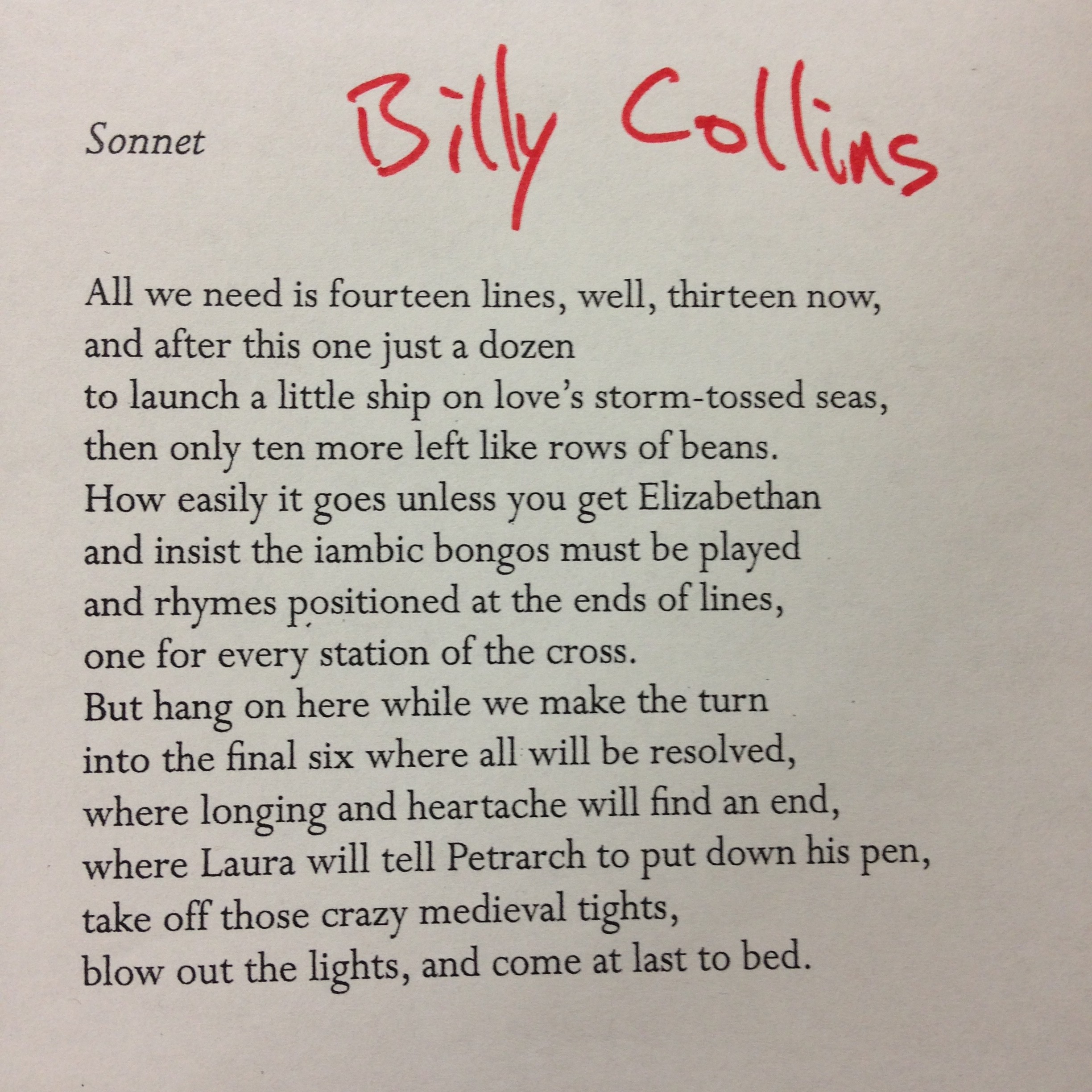
He’s not the only one to write sonnets. Here’s a lovely, modern one from Billy Collins:

Image result for billy collins sonnet

Sonnets follow a very strict format:

  • 14 lines; the first 8 “create a situation,” the last 6 “resolve” it
  • predictable rhyming pattern (usually in Elizabethan it’s abab cdcd efef gg, or sometimes aabb ccdd eeff gg for those wild Elizabethans, or another variation, such as Petrarchan with abba abba, then cdcdc or cdecde; Petrarchans are a bit looser in construction–the party boys of Renaissance poetry)
  • usually in iambic pentameter (five “beats” each going “ta-DA”) although occasionally Shakespeare played with a different beat (here’s an interesting Ted Talk about iambic pentameter: https://www.youtube.com/watch?v=I5lsuyUNu_4)
  • stolen from the Italians (it’s sooo much easier to rhyme in Italian than in English; nearly everything in Italian ends in an “ia” or “io” so sonnets are less of a challenge to write in Italian. Cheaters.)

Theme: Shakespeare’s sonnets tend discuss one of three themes: (1) the brevity of life, (2) the transience of beauty, and (3) the trappings of desire.

Literary devices: These frequently crop up in Shakespeare’s sonnets.

  • alliteration
  • assonance and consonance
  • antithesis
  • anaphora
  • enjambment
  • oxymoron
  • personification
  • internal rhyme

Together we’ll go through Sonnet #18 “Shall I compare thee to a summer’s day?” marking everything we can find, from the rhyme scheme and the stressed and unstressed syllables of the iambic pentameter, to all of the literary devices and sound devices.

HOMEWORK: Your turn! Here is a collection of sonnets from which you’ll choose ONE. Read them all, see which one appeals to you most. Mark up that ONE sonnet as thoroughly as possible. THEN you’ll write it up as thoroughly as possible. Follow Sonnet Analysis which will have examples of what we explored today in Sonnet #18. On Monday we’ll go over all of the sonnets, and when we start to discuss yours, you better speak up and tell us what you found!

Your marked-up poem and analysis are due Monday for class.

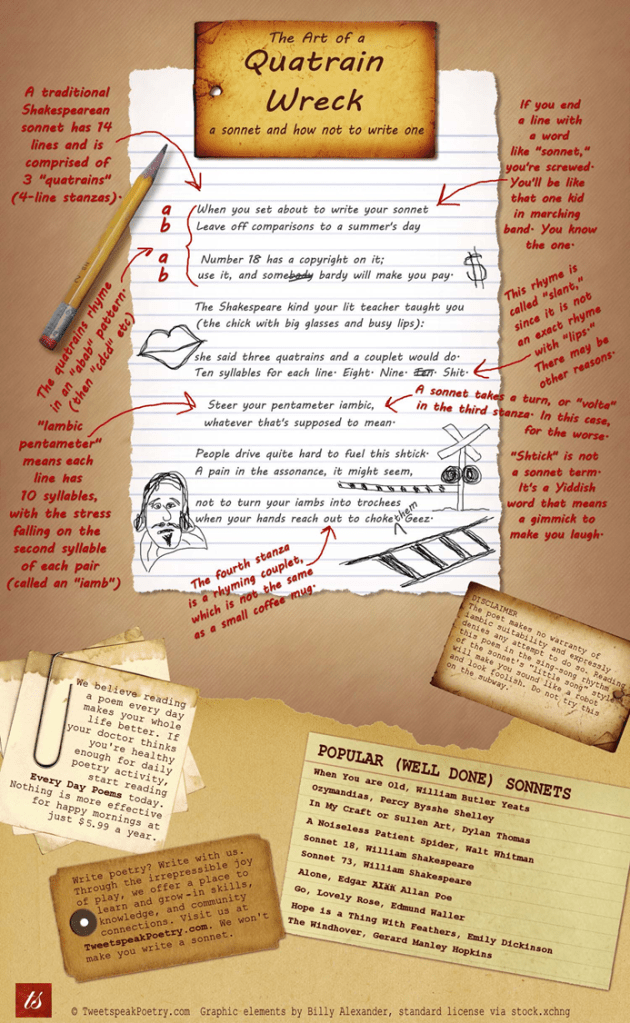
And no, I won’t make you write a sonnet, but here’s some advice if you want to:

March 12, 2020

HAMLET Act 5:2 The END! (I already miss him.)

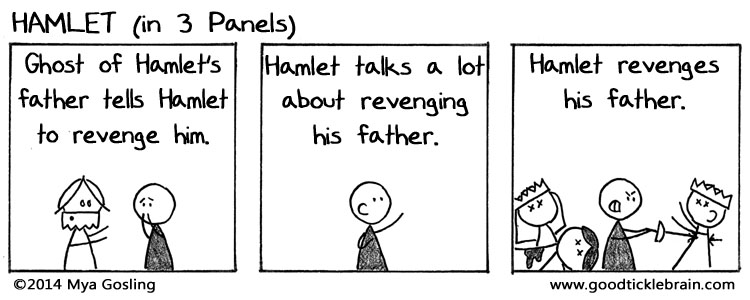
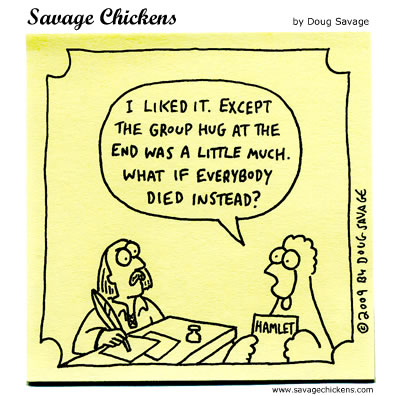
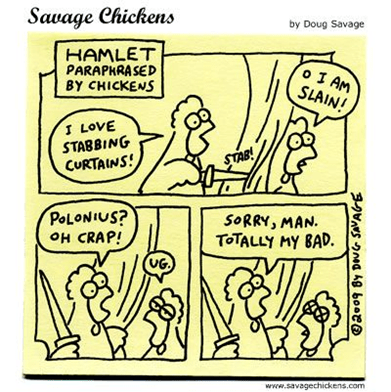
I guess we could have just read this comic and be done with it:

Or we could have read this version:

Image result for savage chickens hamlet

But I thinks it’s far more rewarding to take the scenic route as we did. Let’s discuss what we watched yesterday, but didn’t get to discuss: the fight at the funeral.

Act 5:1–Why do you think Hamlet rushes out and proclaims his love for the dead Ophelia? Does he really love her? Here’s a theory–he did really love her. So then why reject her and push her away earlier? To protect her, until he’d finished the revenge his father demanded. Maybe he didn’t want her to be caught up in all that he had to do to dispatch Claudius, so he put distance between them, which he intended to fix once Claudius was gone. Maybe he did plan to marry her and make her his queen, but everything has gone awry.

Or, less romantically, he really didn’t love her, but is caught up in the moment of the funeral, the shock of seeing yet another death, that he rashly rushes out to proclaim that he loved her, too. Which approach do you think is most accurate? (Hint: True love wins. Or doesn’t. I’m a romantic at my cynical heart so . . .)

The scene sets easily sets up the duel (and in the 2009 production, you can see Claudius’s sly smile as Laertes and Hamlet are fighting–“Ooh, this is too easy.” I’m surprised he doesn’t start rubbing his hands like a James Bond villain in anticipation).

WATCH the end of the video covering Act 5:2, 2:46:42–3:01:00

Again, many sections in the video are skipped, but the major points (except for two–HAMLET’S ESCAPE! and FORTINBRAS!) are here:

Hamlet’s escape and the undoing of Rosencrantz and Guildenstern: they had a letter to present to the king of England, which Hamlet found one night while wandering around. It was Claudius’s demand that Hamlet be killed. Now that Hamlet realizes that he’s a target, that seems to finally convince him that Claudius must go! He writes another letter, seals it with his father’s ring, and lets R&G deliver that to king which says, essentially, “Kill the bearers of this letter.” Clever, Hamlet, clever.

Hamlet then expresses his regret about getting all up in Laertes face at his sister’s burial. “He was just so upset, so I got all upset . . .” Competitive boys, I wager. But he realizes how much they have in common at that moment, both losing fathers and Ophelia.

Enter Osric, guy who has a position in the castle only because he owns lots of land. Money, not matter, is what gives someone position. He’s sent to tell Hamlet (through far too many big words that he runs out of them) that Claudius has set a bet that he could beat Laertes in a fencing duel. Now, to me this seems like really weird timing: we just had a burial, it was awkward and emotional, and so . . . Hey, I know! Instead of mourning, let’s have a fun duel with bets and drinking (that Claudius is always looking for a reason to drink–Hmm, we just may have found one of his major failings). Hamlet’s like, Sure, whatev. This place is making me feel weird. He feels the odd vibe (calls it something that “would perhaps trouble a woman”–suggestion a “woman’s intuition” feeling), as does Horatio, who says, “Hey, I can postpone this for you.”

Hamlet gives an interesting little speech, again not in iambic pentameter but prose. creating an allusion to something Jesus Christ said to his followers:

Are not two sparrows sold for a farthing? and one of them shall not fall on the ground without your Father. . .

Hamlet says “there’s a special providence in the fall of a sparrow,” suggesting that God pays attention even to that fall. But here’s the interesting part, which most of Hamlet’s audience would have known–what follows that line:

Fear ye not therefore, ye are of more value than many sparrows. (Matt. 10: 27-29)

Hamlet seems to take new strength and resolve here, likely recalling the rest of that line to “fear ye not.” He realizes that someday, he’s going to die, and the God already knows that time and day. Maybe it’s today, maybe it isn’t. Does that matter? As if knowing his great worth and finding new faith, he says,

“If it be now, ’tis not to come. If it be not to come, it will be now. If it be not now, yet it will come—the readiness is all. Since no man of aught he leaves knows, what is ’t to leave betimes? Let be.”

Quickly a crowd forms for the duel, and although Hamlet is the first one pricked with the poisoned sword, he’s the last one to die because it’s more dramatic that way.

But first, Hamlet tries to make up with Laertes, apologizing and essentially blaming his insanity for his problems. So if Hamlet really is just faking his insanity, then . . . this explanation is a load of tosh. But if he is crazy–and thinks he may be–then it’s a legitimate apology. So which is it?

Here’s a helpful graphic to keep the next few minutes straight:

20150730-S-HamletDeathClock.jpg

In fencing, there’s not supposed to be any blood drawn, so when Laertes and his sharp blade nicks Hamlet, Hamlet’s startled and incensed. But before this, notice how quickly Claudius offers Hamlet the poisoned cup with the fancy pearl reward in it? Just one touch on Laertes and Claudius is already panicking that Hamlet might not get stabbed properly.

So keep track here: Hamlet’s stabbed first with the poisoned sword (the stabbing isn’t severe) so he keeps fighting.

Next, Gertrude decides to drink to her son, grabs the poisoned cup, and downs some poison. Do you think she knows what she’s doing? She says to Claudius, who tries to stop her, “Pardon,” so maybe she does? Maybe not? She seems genuinely surprised a minute later to be falling on the ground, dying. Or maybe she blurts out about the poison to warn Hamlet what did her in.

The swords get switched in the middle of this melee to see what’s wrong with Gertrude, and Hamlet stabs Claudius, FINALLY doing what he’s been trying to do for months now. In the 2009 production, it’s merely a flesh wound on his hand. But in some other productions, Hamlet gives him a pretty good whacking with the blade, which likely causes his death. But for good measure, drink your poison too, Claudius! He quickly dies, but from what, not sure.

Which scenario would be more satisfying: 1) that Claudius dies from the poison he made, or that 2) Hamlet actually avenges his father and kills Claudius with the sword? Oh, also that’s poisoned as well–by Laertes, whose family has also suffered because of Claudius–so 3) there’s three ways Claudius dies. Maybe its a combination of all three that kills him off? That’d be most satisfying, I think: everything comes down to bear on Claudius, all at once.

Next on the death clock is Laertes, whom Hamlet wounds with the poisoned blade. Again, some directors stage this as a major stab, that Laertes dies more quickly because of the stabbing rather than the poison on the blade. If it’s the poison, though, then Laertes has killed himself. But if it’s the stabbing, then Hamlet is culpable. Nobly, Laertes forgives Hamlet and asks forgiveness of him, which Hamlet grants.

Can you see how this would be a very difficult murder case to prove? Who killed whom?

Now that all the major players are gone, we’re left with Hamlet who falls into the arms of Horatio to die (yay, Horatio! Best friends forever!). Horatio wants to join Hamlet in death, but Hamlet argues that someone has to set the record straight as to what happened, so that centuries later someone could turn the story into a play, and centuries after that we could read it as a class. (So freaking cool.)

Some argue that, really, Hamlet should be dead by now, but if he’s only nicked, then he does have that “less than an hour” Laertes promised him so that he can make a few speeches. (Shakespeare made sure of that. Can’t just have the hero drop without last words, and lots of them.) Hamlet suggests that Fortinbras will take over, and that he has Hamlet’s vote, and with that, he’s gone.

The 2009 production ends there, but in the play, the audiences in Shakespeare’s time would have wanted more of a wrap-up. Enter Fortinbras and friends, fresh from the win in Poland, to walk into this blood bath. They have news:

Image result for rosencrantz and guildenstern funny

And Fortinbras’ ambassador wants thanks for the deed, but for rudeness–everyone of importance is dead!

Fortunately Fortinbras is a little more level-headed, recognizes sort of what’s going on, and declares that Hamlet should be given all honors as if he’d been king, because he would have been a good one.

And that, my friends, is the story of how Fortinbras beat Denmark without even raising a sword. Yep, after everything, Fortinbras wins.

Wow.

As a foil for Hamlet, he’s perfect. Do you remember what day Hamlet was born? The day his father Hamlet Senior defeated Norway and Fortinbras’s father. What day did Hamlet die? The day Fortinbras Junior takes over Denmark, fully avenging his father’s defeat 30 years ago. It’s as if Fortinbras has been living his own play in the distance, and at the beginning and very end it intersects Hamlet’s play, bringing a conclusion to both of their stories.

Man, that’s so beautiful. Not only is Shakespeare brilliant with language, depth, and breadth, but he creates incredible plots that come together at the end. (So I can easily forgive him for that deus ex machina “helpful pirate” bit earlier.)

HOMEWORK: Now we can’t let this go without one last Hamlet Essay, and this one, you get to choose. HERE are SIX PROMPTS from which you get to CHOOSE ONE to write about. These are all from past AP Exams, and each could use Hamlet to complete them. Choose which one appeals to you the most and write your last Hamlet Essay. Spend only 40 minutes on it. This will be due tomorrow.

March 11, 2020

Hamlet Act 5:1 (fight at a funeral)

Essay Practice! Your favorite! We’re going to discuss how to address this essay prompt, then I’m going to give you 30 minutes in class to write it up.

Open Response Question from the 2007 Form B AP English Literature Exam:

Works of literature often depict acts of betrayal. Friends and even family may betray a protagonist; main characters may likewise be guilty or may betray their own values. Select a novel or play that includes such acts of betrayal. Then, in a well-written essay, analyze the nature of the betrayal and show how it contributes to the meaning of the work as a whole.

List O’Betrayal in Hamlet

  • Claudius betrays his brother King Hamlet
  • Gertrude betrays her husband King Hamlet by marrying his brother
  • Gertrude betrays her son Hamlet by siding with her new husband Claudius
  • Hamlet betrays his girlfriend Ophelia by dumping her, toying with her emotions, then killing her father Polonius
  • Rosencrantz and Guildenstern betray Hamlet to England for the king’s payment
  • Additional betrayals? (There are quite a few to choose from.)

Next, what are some major themes in Hamlet? We’ve already discussed loyalty, as well as appearance vs. reality. What other themes could you incorporate?

Choose which betrayal is your favorite, then create a clear, concise thesis sentence, such as this one: In Shakespeare’s Hamlet, Rosencrantz and Guildenstern’s betrayal of Hamlet emphasizes how greed corrupts friendship. This corruption of relationships creates a disparity between how people appear and how people really are.

30 minutes to write the essay, handwritten.

WATCH 2009 video: 2:34:47–2:46:50 (about 12 minutes)

We’re skipping some of the clowns dialogue, but a few points about suicide and intent are interesting.

We’ll also look at the Yorick speech which is NOW when Hamlet holds the skull, and it’s really not that much of a speech. I think the skull just gets to people, so they remember that.

Far more memorable is Laertes diving into his sister’s grave to hold her and be buried with her, then Hamlet rushes over claiming that he loves her 40,000 times more than a brother (what do we call this kind of language? Yes, hyperbole). Then Hamlet confesses his love (a little late, bro) and Laertes has even more reason to revenge on him. Good old Claudius steps in to get Laertes even more riled. Who says he’s not a good king? All of this sets up for an epic read tomorrow . . .

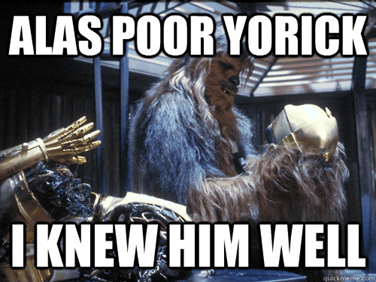
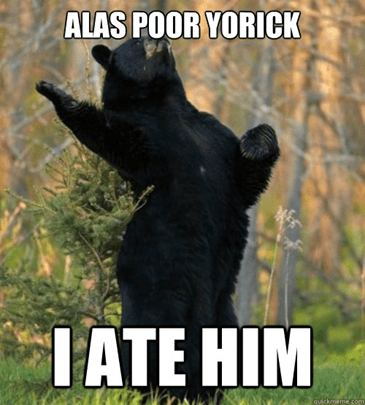
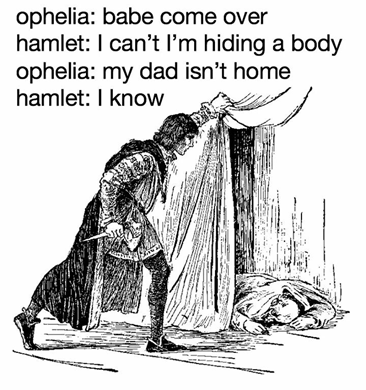
But first, more Yorick comics:

HOMEWORK: Act 5:2–THE END! Nooo . . . But alas. Create 1 Ham Log.

March 10, 2020

Hamlet Act 4:1-4 (Ophelia’s mourning, Hamlet’s escape, Laertes’ return, Ophelia’s horticulture and swimming lessons) (because there’s some confusion as to which act and scene is which, for those following in No Fear Shakespeare, this is what you should have read)

The 2009 production skips quite a bit and cuts a lot of dialogue, but the best parts are retained. We’ll watch from 2:15:02 to 2:34:47 (about 20 minutes).

The front cover of your book is Sir John Everett Maillas’ painting of Ophelia, completed around 1850. Here is it fully:

John Everett Millais - Ophelia - Google Art Project.jpg
Notice the flowers she’s holding, and wearing a much larger dress that would indeed weigh her down.

Main points of this reading:

Ophelia’s reaction to her father’s death–does she love him? What’s Gertrude’s reaction to Ophelia wanting to see her?

Laertes is quite upset with Claudius, and what’s his “natural” assumption about the cause of Polonius’s death? That Claudius did it? Now, why would he assume that? (They hastily buried Polonius–no state funeral with military honors as he was supposed to receive.) Laertes is highly suspicious. Does he suspect Claudius had something to do with King Hamlet’s death?

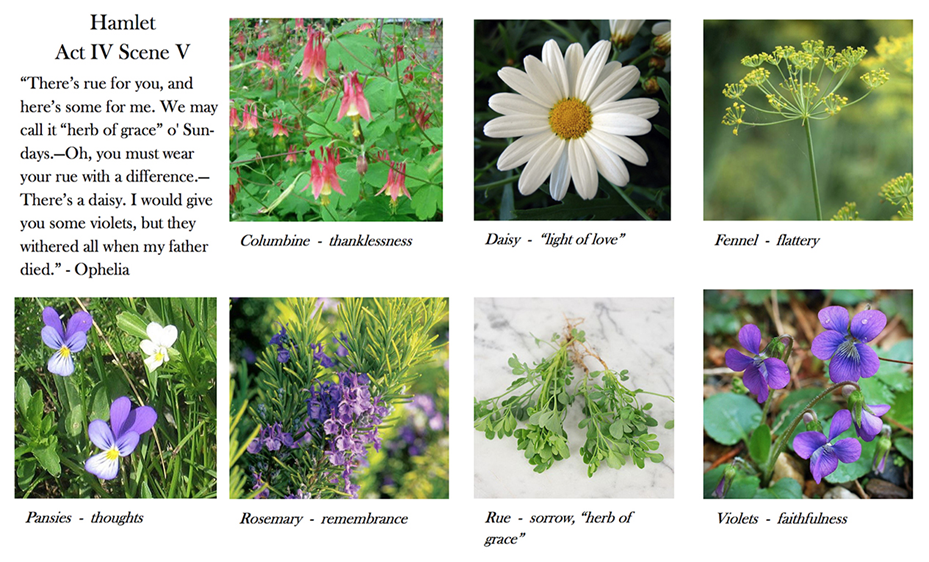
Enter Ophelia with her horticulture lesson. She’s clearly mad, but also very brave, tossing around insults as well as sorrow. Flowers had meanings, even way back then, and she lectures them as she gives them flowers. (In some productions, she hands out nothing but only acts as if she has flowers.) In this one, she hands out various weeds and calls them whatever.

Here’s an explanation someone else once put together, which I stole:

To Claudius, she gives flowers that represent flattery and ingratitude, and to Gertrude she gives her rue which is for both repentance and sorrow, so when she says that Gertrude needs to wear hers with a difference, she means for Gertrude it’s repentance, for Ophelia it’s for sorrow.

And, according to the songs Ophelia sings, what kind of relationship might she have had with Hamlet? A little more involved than anyone knew, perhaps?

The reactions of Laertes and Ophelia open an interesting question: just how guilty do they think Gertrude and Claudius are regarding King Hamlet? And does the rest of the castle, and indeed Denmark, think they are guilty of some misdeeds as well?

Remember how we discussed appearances and reality yesterday? Maybe the reality of Denmark and its people is that they suspect Claudius and Gertrude of poor behavior. The facade (appearances) they’ve held up is crumbling.

So that’s why Claudius comes up with strategy #2 for killing Hamlet, who has escaped by reason of some helpful pirates. (Ah, the helpful pirates! So many stories written about them . . . Well, there should be.)

After convincing Laertes that he didn’t kill Polonius, and that Hamlet did, Claudius proposes Laertes and Hamlet have a fencing match, but he’ll assure that Laertes’ sword is unblunted–sharp–so he can stab Hamlet (plot #2).

And if THAT doesn’t work, Laertes just happens to have a vial of poison on him (seriously, who goes around with a vial of poison? What does that suggest about his character?) (plot #3, or 2b, since it builds off of Claudius’s plan).

And if THAT doesn’t work, Claudius has another backup plan–which he comes up with in about five seconds, proving that he’s becoming more adept at plotting deaths at a moment’s notice (good to have hobbies): he’ll have a glass of poisoned wine (plot #4).

One of those three methods ought to kill Hamlet, right? (Come on, Claudius–it was easy to bump off your brother, why are you struggling so much with your nephew? Sheesh. What kind of villain is he?)

Then, we have Ophelia’s death, reported by Gertrude. It’s quite a romantic scene, as you can tell from the painting, a lovely girl dying because her lover killed her father.

But it’s also full of questions: who witnessed this? Did anyone try to help the poor girl?! And, a big question worrying Elizabethans–did she commit suicide? (Remember Hamlet’s speech “To be” and the big questions? What about Ophelia?)

A few more important points:

Appearances: How often is Claudius trying to make everything look “right”?

FOIL—not the mathematical kind, and the fencing kind (that’s tomorrow) but the literary kind: someone else in a similar situation held up to our protagonist as an example of another way to handle the same problems. We have three for Hamlet in these scenes.

First, Laertes–how quickly does he act to get revenge for HIS father’s death? (We’re still waiting, Hamlet.)

Second, Ophelia–how quickly does she go insane and die? (Hamlet, is your craziness even real?)

Third, Fortinbras–we haven’t even met the guy, but he’s engaged 20,000 soldiers to fight for a tiny cause his father lost, just to prove his honor. (Hamlet, how many soldiers have you engaged? Kind of sad, buddy.)

And Hamlet knows he’s pathetic compared to Fortinbras (he doesn’t yet know about Laertes and Ophelia). Nonetheless Hamlet does what he does best: he sits and stews and feels guilty.

Here’s an interesting question, a twist on what you may expect: Perhaps Hamlet’s response is because he IS so sane, and not insane. Would a sane man really rush in to revenge? Maybe his real problem is that he’s not crazy enough.

Maybe Laertes, Ophelia, and Fortinbras as making very poor choices in the same circumstances, and Hamlet is the proper one demonstrating how to do things better.

If that’s the case, who is being “better”? What, really, should Hamlet do next?

HOMEWORK: Read Act 5:1. You may skip the “Clowns” speaking and go straight to Hamlet and Horatio entering the scene. The beginning of this scene made a lot of sense back in Shakespearean times–it was meant as a “light” moment after so much heaviness in the play, and all of the jokes were funny at the time. Now, none of us have any idea what any of it means, so like everyone else who attempts to read it, we skip it instead. Create 1 HamLog.

Because it’s a short reading assignment, I’m also going to give you 10 more questions from an AP Lit Exam from 2012. Read the poem on page 8 (dated 1667, so it’s similar language to what we’re dealing with right now) and answer questions 24-33. Spend ONLY 10 minutes on these.

March 9, 2020

Hamlet Act 3:4-7 (or Act 3:4, and Act 4:1-3) (from Hamlet confronting his mother to Claudius wanting England to kill Hamlet)*

*I’m not sure why our book is different than No Fear Shakespeare. Different editions have different act breaks? Sorry about the confusion here, but it sounds like most of you figured it out.

Before we watch the video, I want to go over some important lines about mirrors. In the 2009 video we already saw Hamlet reflecting light with a mirror at the players, in Act 3:2:

“[The purpose of acting is] to hold, as ‘twere, the mirror up to nature; to show virtue her own feature, scorn her own image, and the very age and body of the time his form and pressure.”

Acting, like mirrors, are to show us who and what we really are. Mirrors don’t lie, they say.

Now, when Hamlet confronts Gertrude, he tells her,

“Come, come, sit you down; you shall not budge; You go not till I set you up a glass (mirror) Where you may see the inmost part of you.”

He wants her to see what’s really going on, how the illusion of what she’s done by marrying her brother-in-law (and whatever part she may have had in her husband’s death, if she has any) is coming apart, even shattering. Watch what happens with the mirrors in this scene forward.

(Do you remember Ophelia on the floor, weeping about Hamlet? The floor was a perfect mirror for her. There will be no more perfect mirrors.)

What do all of these broken mirrors signify? (Mirrors are a symbol—an object that is itself, yet also represents something more. Here in this production, because they are used so often, they become more than just a symbol but now a motif, which is when a symbol is used more than twice as a part of the story.)

Image result for ophelia hamlet 2009

WATCH VIDEO from 1:53:53 to 2:15:00

Go through the major points of the scenes, address questions. What is Hamlet’s relationship with his mother now? How does she seem to regard him? Remember how we talked about loyalty being a big theme in this play–to whom is Gertrude loyal? (Or is she torn between both of the major men in her life?)

What about the business of King Hamlet’s ghost reappearing? Why does Gertrude not see him? There are several possibilities: she doesn’t want to, maybe she does but she’s pretending she doesn’t see him (probably not likely; all of the folks freak totally out when they see a ghost), she’s not “supposed” to, or maybe he’s not really there at all. Maybe this is latest appearance is only in Hamlet’s brain–his imagination (“ecstasy,” his mother suggests). If that’s the case, what does that suggest about Hamlet’s mental state?

Are you sad to see Polonius go? Hamlet has some of his funniest lines in the scenes after he drags away Polonius. Why? (Shakespeare liked to interject some humor at heavy points in his plays, to keep the balance, some critics believe.) Maybe also because if Hamlet is truly crazy, he’s also truly funny. There’s also the theory that humor springs from intelligence, and as quickly as Hamlet is coming up with his barbs and jab, he may be demonstrating his sheer intelligence. Would that suggest that he’s just very, very clever and not insane, but in complete control? (This is THE question, asked about this play for about 417 years now . . .)

And now, some jokes about Polonius:

HOMEWORK: Hamlet Act 4: 1-4 (again, a few scenes are VERY short) OR Act 4:4-7 because No Fear Shakespeare is different. (In our book, it’s pages 114-132). Create 2 Ham Logs, covering whichever scenes you wish (but you won’t find too much great stuff in the one page of scene 3, so choose from other scenes).