This is a short scene, and since we have a number of students out for the one-act plays, we won’t be covering too much Hamlet but will instead look at various productions of it.
We’ll watch the 2009 production from 1:46:20 to 1:53:53.
Do you feel any sympathy at all for Claudius? He does seem penitent and full of regret. Why can’t he pray, then? What about Hamlet coming to dispatch him? Should he have, anyway?
It’s interesting to see different takes and uses of Hamlet. It’s all over, in many places. As someone said in class yesterday, “That ‘To be or not to be’ speech–I feel like I’ve heard it in other places.” Yes, yes you have.
First, let’s watch this is creative, insightful, and at times ridiculous adaption of Hamlet. This section is from “The Complete Works of William Shakespeare, Abridged.” These three guys perform all of Shakespeare’s works in one play, but spend the greatest amount of time on Hamlet. For today, we’re going to watch ONLY to minute 30:00, which is as far as we’ve read. (We’ll cover the rest of this once we finish the play.)
Here’s a compilation of various performers doing “To be or not to be”. (I’m not sure how many of these clips we’ll get through during class–here’s what you can watch while you’re bored one day.)
Patrick Stewart (yep, Claudius again), on “Sesame Street.” Seriously, Sesame Street:
Here’s the scene from “The King’s Speech” where he’s conned into reading the speech. (I’ve not been able to find a clip of him listening to himself reciting the “To be” speech flawlessly. Awesome scene. Find the movie and watch it if you haven’t. It’s one of my favorites. I just hit the mute button during the two incidents when he demonstrates how he doesn’t stutter when he’s swearing):
Here’s from “Star Trek: The Undiscovered Country” (recognize that line?!). Here they refer to it as “the future” which isn’t entirely incorrect. Beginning at around 4:30 we have an awkward dinner between the Federation and their enemies, the Klingons, where Shakespeare again makes an appearance. (Some day I’ll learn Klingon to most fully appreciate William.):
And one more, to let you hear David Tennant’s Scottish accent:
HOMEWORK: Read Act 3: 4-6. Scenes 5 and 6 are very short. Create just ONE Ham Log for the entire reading.
Today we encounter the most famous speech: “To be or not to be.” And now you’ll see how many people get it wrong. Quite often Hamlet is depicted holding a skull, but that’s ANOTHER soliloquy–not this one!
The 2009 production skips around here, so will we, to keep it in line with the text:
VIDEO: 56:44—1:05; THEN 1:26:22—1:46:20
Go through major points of the speech.
Now, we’re going to look more closely at the “To be” speech as we did with the speech yesterday, and today we have a purpose: this once appeared as an AP Essay Exam, and yes–you get to write it up! But we’ll go through the major points it asks for in class together, then you’ll write the essay for your homework.
How to answer the question: look VERY carefully at the parts of the prompt to see exactly what it wants us to do.
“. . . in a well-organized essay, briefly summarize Hamlet’s thoughts, and discuss how the diction, imagery, and syntax of the soliloquy help to convey his state of mind.”
CROSS OUT “briefly summarize Hamlet’s thoughts”–the AP Exam no longer wants ANY summaries, so skip and let’s get straight to analysis:
Sometimes it helps to work backwards.
What is his state of mind?
What imagery is created to explain that state of mind?
How does the diction and syntax create that imagery?
The POWER OF DICTION–creating a style and feeling based on the words used:
Take your notes that we create in class today and WRITE this essay at home as part of your homework. To give you practice in the exam, HAND WRITE the essay on lined paper, and LIMIT yourself to 30-40 minutes. Try to get two full pages written to hand in tomorrow.
The 2009 production shifts scenes a little, but we’re going to watch it in order of the text. We’ll watch beginning at 1:05:05 to 1:26:20
What questions do you have?
When Hamlet first meets Rosencrantz and Guildenstern, his speech shifts: it’s in prose, not iambic pentameter. He does this a few times, you’ll notice. Some theories why? It makes him more common when he’s speaking to others. Also can be a sign that he’s more mad—his language isn’t as careful or lyrical.
HANDOUT: “I have of late lost all my mirth . . .” speech. Let’s also look more closely at the language, the descriptions. We have done that yet with Shakespeare, and this is a good place to examine what he’s doing, going line by line.
Two schools of thought about approaching this speech (and directors play it both ways): 1) Hamlet says it ironically or sarcastically, or 2) he says it sincerely.
How does the speech change when you look at it in those different approaches? How do you think he means it?
And here’s our King Claudius, (years ago when he’s in his late 40s), as Capt. Jean-Luc Picard in “Star Trek: The Next Generation,” reciting part of this speech. What’s his take on it? (Sir Patrick is 69 in the production we’re watching.)
HOMEWORK:Read Act 3:1-2. EXCEPT, there’s a big section of Player Queen and Player King which you may skim. It’s the actors Hamlet has performing the play, and it gets a little tedious. Skim but pay attention to Hamlet’s interjections, especially when he says, “Wormwood, wormwood”—look at the four lines before it. Kind of nasty, aimed straight for his mother. Pay closer attention again to when Hamlet asks Gertrude, “Madam, how like you this play?”
Because Act 2:2 is long, we’re going to cut it in half.
The 2009 video version skips around a little here. Up to the “Enter Hamlet, reading” it’s mostly ok. We’ll watch from 43:06–56:43. After that (tomorrow’s reading and viewing) it’s a bit muddled in order, but still works out.
CHARACTERIZATIONS: Let’s look at our characters so far, what do you think of them? Describe in a few words these people:
Hamlet
King Hamlet/ghost
Gertrude
King Claudius/uncle
Polonius (how do you feel about him now, after seeing he’s sent someone to spread lies about his son?)
Laertes
Ophelia
Rosencrantz and Guildenstern
Horatio
As the play progresses, we’ll revisit this list and see if your perceptions of their characters has changed.
WRITING PRACTICE: Answer the following statement in 10 minutes, handwritten–“Do you feel that Hamlet’s sadness over his father’s death and his mother’s remarriage is justified? Why or why not?” First answer yes or no, then create a paragraph explaining your position.
What else did you find in your reading/writing?
HOMEWORK: Finish Act 2:2. Create a Ham Log.
(Below is actually from yesterday’s scene, but I just found it today, so . . .)
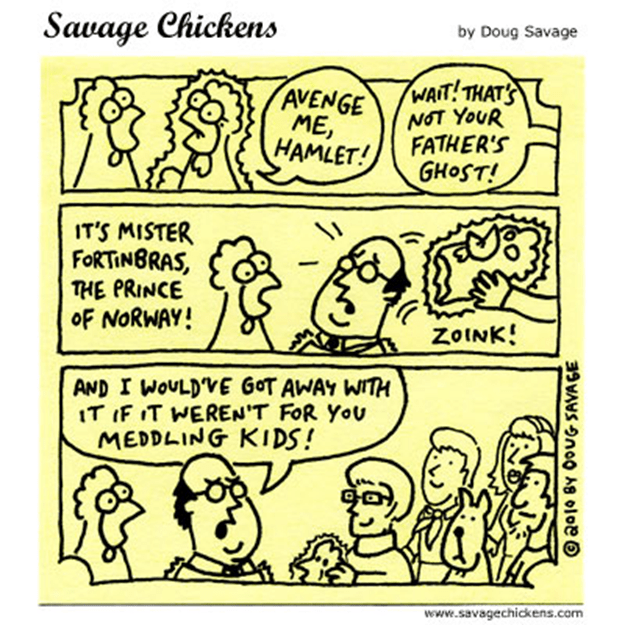
Alas, Scooby and the gang aren’t around yet, so we have to take the ghost at his word. Or so believes Hamlet.
But first. Ophelia and her family. What’s her relationship with her brother? Genuine? What kind of advice does he give her? What advice does she give him in response?
Enter Polonius–ah, Polonius. Many people have tried to figure him out. He gives a lot of advice, and we’re going to look at it. How much is good? Is self-serving? Is reliable? What kind of a dad is he? How would we characterize him?
Now, another young man and his dad–Hamlet, and his Ghost Daddy. With Horatio and Marcellus, he waits for the ghost, and when it appears, how do his friends react? (We should all have such good friends.)
Hamlet meets privately with the ghost where he hears about murder most foul.
It’s important to understand some of the allusions presented in this scene. Shakespeare refers subtly to the Garden of Eden, and Cain and Abel. We’re going to go over those stories from Genesis. (If you want to read the full stories, read Genesis chapter 2-4.
Adam and Eve placed in the Garden of Eden.
Told not to partake of the Tree of Knowledge of Good and Evil.
The devil, as a serpent, “beguiles” (coerces) Eve to partake of the fruit.
She convinces Adam to do so as well.
They are cast out of the Garden of Eden, become mortal, but now know enough to begin having children and getting the human family going.
Among their children are Abel and Cain. Abel’s the good one, offering proper sacrifices. Cain’s the unrighteous one, listening more to Satan. His sacrifice is rejected by God because Cain really loves Satan.
Cain, furious, rises up and kills his brother so that he can have all of his brother’s wealth.
God notices and curses Cain.
See any connections to what’s happening in Hamlet? Where’s King Hamlet when he’s poisoned in his ear? Who does he say does this? Who is the other person involved in this scheme? What does Claudius get after his brother’s death?
Learning of how King Hamlet dies sets of Hamlet jr., which is convenient because what does his father want him to do? Avenge him!
Hamlet agrees, saying he’ll put all other thoughts from his mind and focus solely on vengeance, since his father is suffering since he was denied the ability to repent before his death, and now suffers in purgatory, burning away his sins until he is good enough to get into heaven.
Hamlet decides to put on an “antic disposition” and feign madness while he works through this plan. What does he ask Horatio and Marcellus to do for him? Again, super great friends. Be that friend who doesn’t tell the court that the madness is all pretend.
Here’s an excellent analysis about how audience would have reacted then, from Cliff Notes:
King Hamlet’s ghost introduces himself in a way that most certainly evoked the sympathy of the Elizabethan audience. He tells Hamlet that his brother robbed him of everything he was, all that he owned, including his everlasting soul. In the same way that the Bible engenders sympathy for Abel and condemns Cain for the fratricide, Shakespeare favors the murdered brother.
Hamlet is quick to believe the Ghost because the spirit’s words confirm his worst fear: Claudius murdered King Hamlet. For the Elizabethan/Jacobean audience who attended the first performances of Hamlet, murder of a king was in itself cause for alarm. Consider that the English people believed that their monarchs ruled by Divine Right, that God Himself appointed them to rule the land. The Church of England went so far as to attribute to the monarch the highest order of executive power in the church as well. In all ways, the English monarch represented God on earth. King Hamlet’s murder makes the Ghost a most sympathetic figure to Shakespeare’s audiences. No one would have questioned the existence of that Ghost, and few would have believed — even for a moment, as Hamlet does — that the Ghost could be a devil.
The fact that his mother’s lover is also her husband’s murderer exacerbates Gertrude’s crime of incest. Hamlet is bereft of choice. He may have an aversion to violence, and he may live by strict Christian principles, but he must avenge his father’s honor. Hamlet sees no way to honor his father except by killing Claudius. Doubly impelled by his father’s orders and by tradition, Hamlet becomes a prisoner of his obligation for revenge.
Hamlet is a sympathetic character precisely because the notion of revenge drives him while his Christian morality and inclination simultaneously exhort him to be charitable.
On the other hand, Gertrude is a woman who has been led by her weakness and frailty to follow the charismatic devil of a king to his bed.
Hamlet tells Horatio that he plans to feign madness before the King and the court. The madness will render him invisible so that he might observe and discern the best way and time for his revenge. Hamlet’s meaning here remains ambiguous. Is his madness a mask?
And an explanation as to why Hamlet keeps shifting ground during the “SWEAR!” scene:
WHY HE KEEPS SHIFTING GROUND DURING THE OATH: But, further, it is to be observed that he does not merely propose the oath afresh. He first makes Horatio and Marcellus swear never to make known what they have seen. Then, on shifting his ground, he makes them swear never to speak of what they have heard. Then, moving again, he makes them swear that, if he should think fit to play the antic, they will give no sign of knowing aught of him. The oath is now complete; and, when the Ghost commands them to swear the last time, Hamlet suddenly becomes perfectly serious and bids it rest. [In Fletcher’s Woman’s Prize, V. iii., a passage pointed out to me by Mr. C. J. Wilkinson, a man taking an oath shifts his ground.]
HOMEWORK: Read Act 2:1-2 to line 168 (where Hamlet enters, reading a book) top of pg. 63 (it’s a long scene; we’ll cut it in half). Complete Ham Log.
LAST LIT TERMS QUIZ! #4–now you know all the terms necessary for this class. (That was fun, right?)
Before Hamlet, we’ll go over the Great Expectations AP Practice Essay you completed on Monday. I will be grading this and future essays as the readers for the Exam will, by using THIS CHECKLIST. The top half is the checklist I will use, the bottom half is a reference for you for future essays. Since this was your first practice essay, and I wasn’t there to give you any direction, everyone received the same score, unless you were a-MAZE-ing, then you received a few extra points. In the future, I’ll grade more critically, now that you can see the standard and expectations.
NOW HAMLET!
I believe Shakespeare meant his plays to be experienced, not merely read. So each day you will watch the corresponding scenes which you read the day before. Today we’ll watch the first 21 minutes of the 2009 production with David Tennant. Then we’ll discuss some key scenes and issues:
What’s going on between Fortinbras and Hamlet? What happened between their fathers? Why is an emissary now being send to Norway to Fortinbras’s uncle? (And interestingly, it’s Hamlet’s uncle who sends a message to the other uncle. Those meddling uncles . . .)
What are Hamlet’s first lines in the play? Notice that in the production, his line about kin and kindness are out loud to everyone, instead of an aside. That’s a director’s choice and I think works well there. Also notice the fun structure of that line: A little more than kin, and less than kind. See the parallelism, the more and less playing off of each other, the turning of kin into kind. Delicious! And also a bit snarky–already we see Hamlet has some attitude. What does this line mean?
Look at King Claudius’s attitude toward Hamlet and his grieving. Yes, sweet that you’re sad, but your father lost a father, and so on, and it’s enough: ’tis unmanly grief. How would you react to that?
What about his mother, Queen Gertrude, and her attempt to console Hamlet? Hey, everybody dies–it’s natural. How does Hamlet respond to that? The meaning of the word common?
Look at Hamlet’s first soliloquy, about wishing his solid flesh could just melt and that God hadn’t said suicide is wrong. Then he turns on his mother and utters the famous line, Frailty, thy name is woman! Ouch. But is he wrong? How did his father and mother feel about each other before the king died?
The Horatio and friends come tell Hamlet about the ghost, and plan to confront it.
Look at the last lines Hamlet speaks before the scene ends: a couplet. Nearly all scenes end with a couplet–a good signal for the actors that the scene is over. But also as a marker of sorts to signal a resolution, understanding, foreshadowing, or determination by the character of something to come. Foul deeds will rise,/ Though all the earth o’erwhelm them, to men’s eyes. What does this mean? Portend? What will happen to the “foul deeds” occuring?
Iambic pentameter: Most of play is written this way, sounding like a heartbeat in fives: ta-DUM, ta-DUM, ta-DUM, ta-DUM, ta-DUM. Why?
In practical terms, it makes it easier for the actors to remember so many lines. They know the rhythm and meter, and can recall that each line has five beats (pent-meter) which aids in helping to remember what may come next.
Secondly, it’s jarring when that pentameter isn’t maintained, such as when Horatio is questioning the ghost–natural pauses are created.
Third, it creates a lovely flow that keeps the action and speeches flowing. Only for significant speeches do the lines rhyme. Otherwise, no rhyming.
And some scenes aren’t in iambic pentameter at all, but straight prose. Why?
HOMEWORK: Read Act 1:3-5 (Yes, you may use No Fear Shakespeare to assist you.)
Create TWO Ham Logs for this reading: One over scenes 3-4 (they’re short) and one over scene 5.
We’re finally starting him today, and I love, love Hamlet, the poor kid. You’ll see why. On Tuesday you learned a little about Shakespeare and tragedies, as well as completed exercises to immerse you in the English of his day. Today we’ll discuss the play itself and get you started reading and responding.
Hamlet is so huge, it’s like the Grand Canyon. In photos, you see little sections. When you get there, you realize it’s 20 times larger than you ever expected.
Dude, you can’t even . . .
But you can’t explore every facet; you can only take a hike or two. That’s what we’ll do: delve into the most interesting parts as we read. But realize that some universities spend an entire semester on it, and could keep going. We can’t. Even if I could, it’d crush you and me.
So we’re going to take an excursion through it, see a part of it, and realize that there’s enormous amounts we can’t even touch. But I hope to give you enough of a taste of it to understand why it’s such an important play, still 400 years later.
Overview of drama and key terms:
Because we have no descriptions in drama, its biggest part is the text itself.
Dialogue: conversation between two or more characters
Monologue: single character, how they reveal their thoughts to the audience
Stage directions, which in Shakespeare are minimal: playwright’s instructions about movement, action, gestures, body language, and sometimes facial and vocal expression
Kinds of characters:
Protagonist: the central character, leading the play, “main struggler”
Antagonist: opposes the protagonist, “who protagonist struggles against”
Round characters—dynamic, developing, growing and changing.
Flat characters—static, fixed, unchanging, no growth.
Stereotype or Stock characters—typical minor characters you find everywhere, like the surly barman, the flirty maid, the corrupt politician, the nosy neighbor, etc.
Ancillary characters—these set off or highlight the protagonist in various ways. The most common is the FOIL—someone who is compared and contrasted to the protagonist.
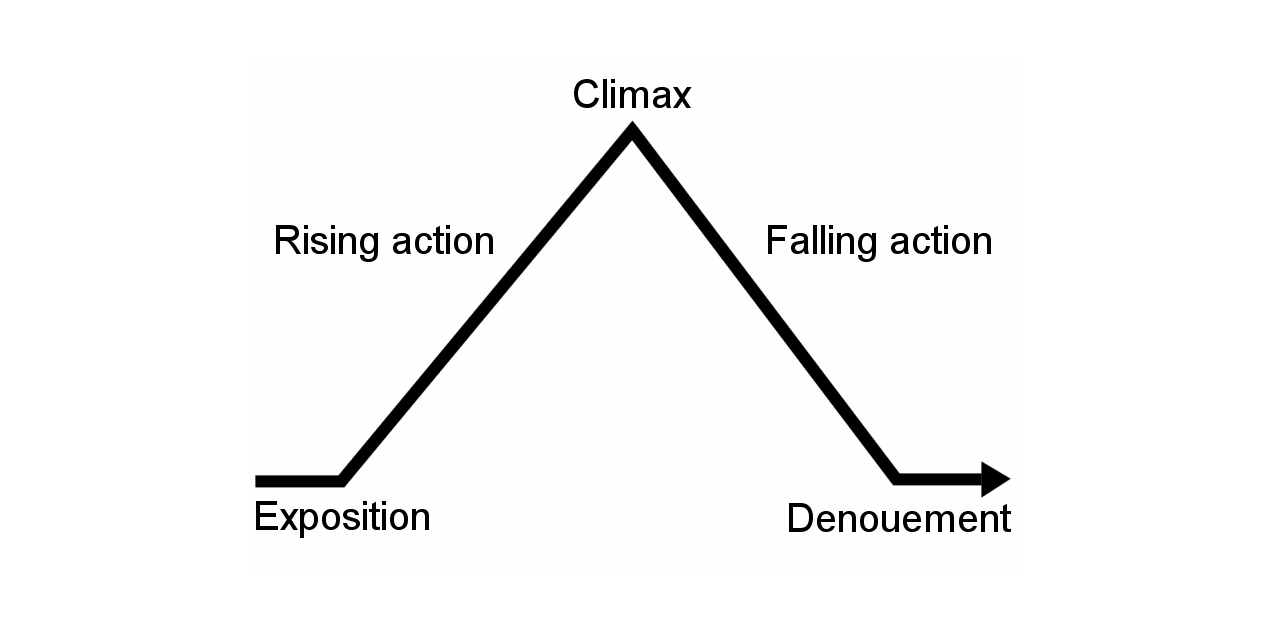
Plays have a common structure. You’ve seen this setup before with short stories.
But with tragic plays, the labels are a little different.
Exposition or introduction—sets up the play, cues the listeners as to the setting, etc.
Complication and development (rising action)
Crisis or climax (main problem reaches its height)
Falling action (picture an explosion, with shrapnel falling down around you)
Denouement, resolution, or, in a tragedy, the catastrophe (because nearly everyone will die; oops, spoiler)
HAMLET ATTITUDES as you wrote up on Tuesday with the substitute. What do you believe?
Power is a corrupting force
Revenge is the best way to get justice
You should always trust your family and friends
Ghosts are real
What do you already know about Hamlet? (Ever see “The Lion King”? Loosely based on Hamlet.)
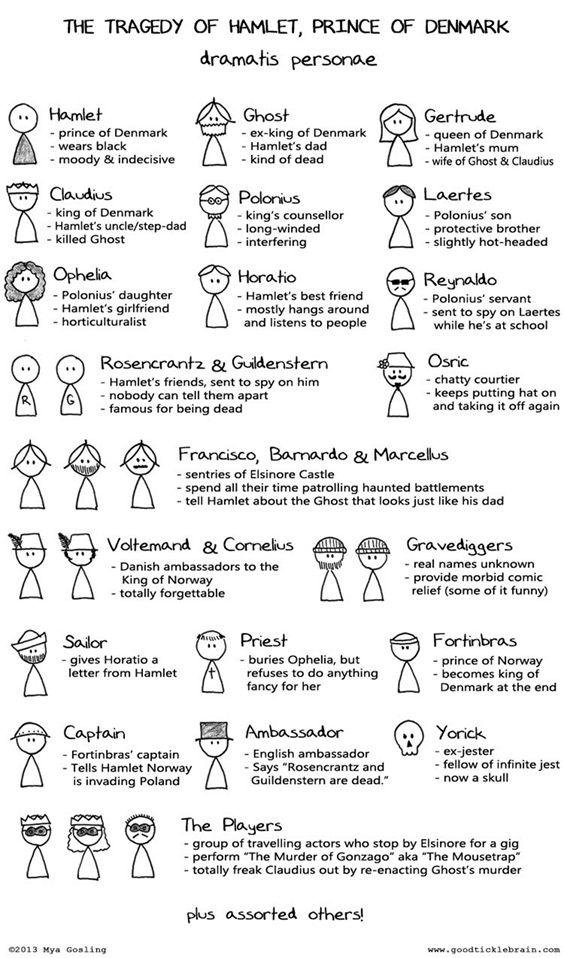
It’s best to understand the play’s end from the very beginning, so I’m going to commit major spoilers today with these handouts.
First, the characters:
It’s important to understand the entire story before we start reading, so here come the major spoilers!
For each night’s reading you’ll also complete a reading log which, a couple years ago, students dubbed Ham Log, and that works. Follow the directions on that link. You will need to read AND write EVERY NIGHT, so do NOT FALL BEHIND!
HOMEWORK: Read Act 1 Scene 1 (1:1) and Act 1 Scene 2 (1:2). We began Act 1:1 in class but didn’t finish, so finish it on your own.
IF you find the language daunting, even with the footnotes, then you may also go here to read: No Fear Shakespeare. It shows the original text on the left, the updated translation on the right. I confess I go here to puzzle out difficult passages or figure out references and idioms that leave me scratching my head. Please still read the Shakespearean language, then come here for clarification as needed.
AFTER you’ve read both scenes, complete ONE HAM LOG for both scenes, completing 3 of the 7 activities (your choice). Create a Google Doc with your name and Ham Log in the title. Every day you’ll update this log. I will check on it a few times each week and give you credit for each log entry you complete. Do NOT fall behind! You’ll hate life and everyone in it if you do.
Tomorrow in class we’ll go over those two scenes, clarify language, and watch those scenes in the 2009 production of Hamlet. Shakespeare isn’t meant to be solely read, but to be watched and experienced. I believe you have a better handle on the text if you read, write about, then observe the text being performed every day.
Today we went over the two poems you analyzed over the break: “Charge of the Light Brigade” and “Annabelle Lee.”
Remember to turn in your marked up poems, your lists of what you discovered, and any homework you had during the substitute. I hope to have it all graded and recorded by the week’s end.
I’m still slogging my way back from a red-eye to Boston, then a four-hour bus drive, then a two-hour car ride to get home this afternoon, so you get a substitute for one more day. The next work we’ll be reading is Hamlet, so let’s get familiarized again with Shakespeare!
HAMLET! But first, these important messages . . .
It helps to become comfortable with Uncle Bill’s language from the 1590s-1600s, and learn what “tragedy” means, to us and to audiences 400 years ago. Today you’ll watch two videos from Crash Course Theater, then complete a few handouts to drop you into Shakespeare and his language.
You will complete this page to prep you for concepts in Hamlet (and also to give you a snapshot into Shakespeare’s life, and how to draw him, which is very important). You’ll also be given page 3 and 4 of this handout and a few pages from another handout, which I can’t share here but are to help you play with the language some more. We’ll go over these later in the week when we officially begin Hamlet.
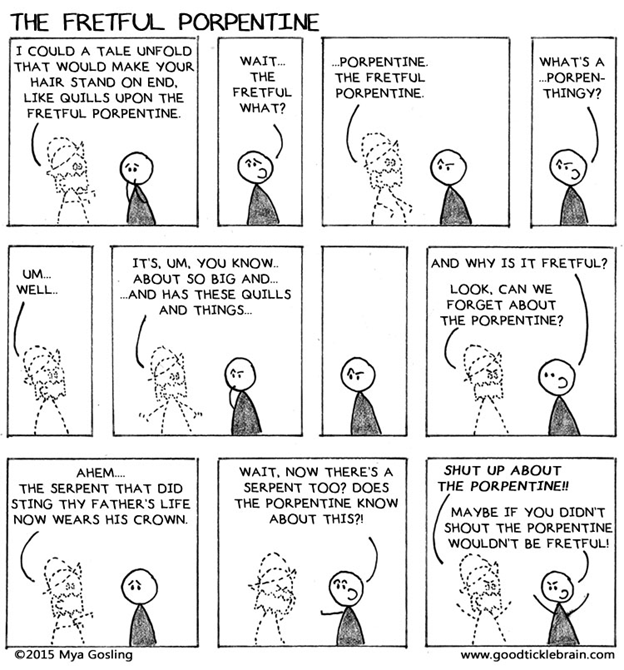
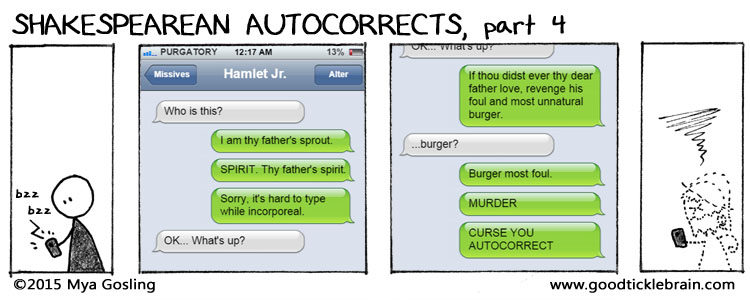
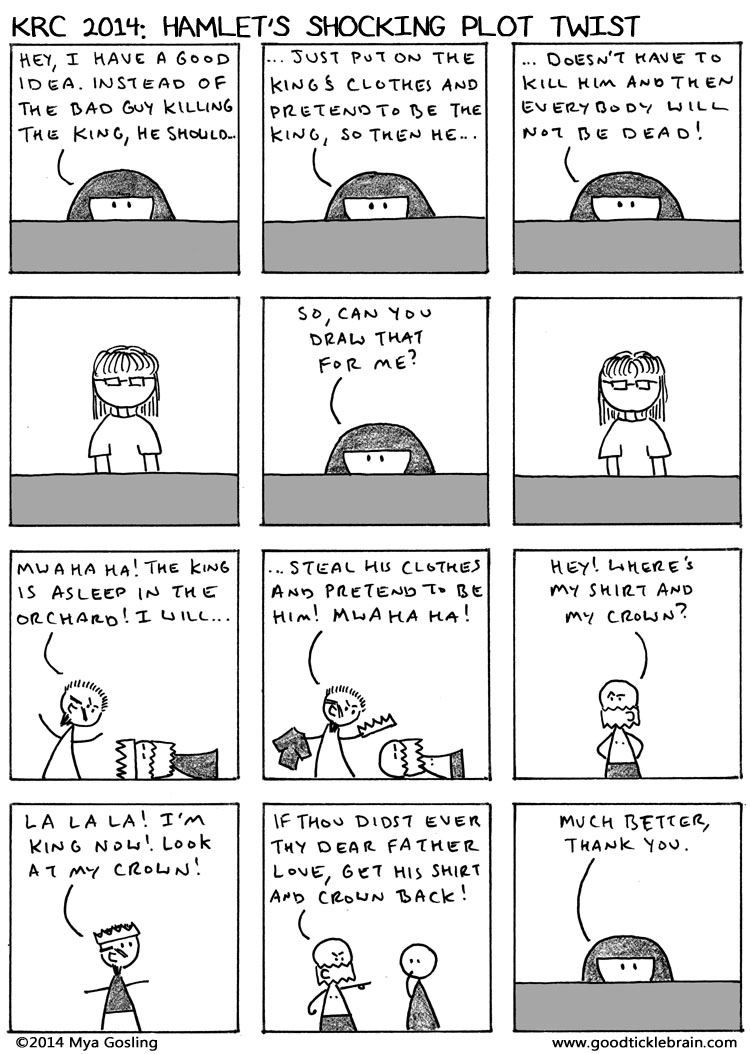
(Good Tickle Brain is a lovely website with marvelous comics of Shakespeare, Hamlet, and a whole bunch of other fun stuff. Highly recommend: https://goodticklebrain.com/shakespeare-index)
Back from break! Well, you are. I’m still playing with grandchildren, so ha.
You have a substitute! Who has a lovely assignment I spent hours creating for you!
Great Expectations AP Essay Exam (Prompt #3)
In class, you will create a prewriting exercise for this prompt, then write an essay based on a past AP Exam question. Now don’t panic–I know you’re still learning how to address these, so the assignment I’ve prepared walks you step by step how to complete the essay. You will be given this Prewriting Assignment to work on during class; once completed, you should have all the information you need to write the exam.
I want this HANDWRITTEN on LINED PAPER so that you can begin practicing for the exam. If you have horrific handwriting (don’t make me name names here) SLOW DOWN as you write to make sure it’s legible. If I can’t read it, you won’t get a score, and the AP Exam Grading Gods have no greater powers of divination than I do, so please– WRITE LEGIBLY!
The essay will be due at the end of class, but if you really, really need more time to take it home, you may. Realize, however, that at the exam you’ll have ONLY 40 minutes from start to finish, and in class you’ll have nearly double that time. Just complete it in class.





 AP Lit, Washington Academy