Remember to complete the Victorian Era Poetry Packet of Elegies and Narratives. We dissected “O Captain, My Captain” by Whitman in class. Now you need to write up all that we found, then on your own dissect the other two poems–mark up the text as much as you can–and write up your findings for us to discuss the week after break.
Use SLAM to help you analyze all aspects of the poems.
I also assigned this Sentence Combining exercise for your enjoyment. You don’t have to follow all of the suggestions, but do find ways to combine the shorter sentences into longer, more sophisticated sentences.
So . . . it’s NOT a snow day as we all predicted and hoped for. Well, that’s embarrassing and discouraging.
But no matter–it gives us time to START ON THE POETRY PACKET I assigned for over the break. Yay us!
VICTORIAN-ERA POETRY
I say “Victorian era” because two of the three poems are actually American, but contemporary and of similar style to Victorians. I want you to complete this packet over the break, but we have time to begin the first poem and class now, so we will.
February Break Work—AP Literature, periods 1 and 4
(This is not to punish you but to keep us on schedule because of our snow days. I don’t anticipate these tasks taking more than three hours. Be kind to yourself and finish them early, before the break even, so you don’t have to stress it. You’ll have all of your ideas written down, so you don’t need to worry about forgetting anything.)
Task One: Poetry
READ the three Victorian-era poems (one British, two American, so technically not “Victorian” but the same time period) which are elegies—a poem in honor of someone who has died; and narratives—a poem that tells story.
MARK up the text of the poems with whatever notes you can produce. Notice if there’s a rhyming scheme, or alliteration, or repetition. Jot down ideas in the margins—there’s lots of space. Identify figurative language, metaphors, whatever else you see in there, and record any comments that you have. (You WILL turn these back in to me after the break and you WILL earn points for marking the text.)
CREATE A RESPONSE for each poem about what you discovered in it. Follow SLAM. This is not a formal essay, rather a way to list all that you discovered in the poem. It may be best to follow the outline of SLAM: first list what you discovered about the Structure, then the Language, then the Affect, then the Meaning. Write it up however is comfortable for you—bullet points, paragraphs, lists, whatever. The purpose is to create a page where you put down everything you discovered and understood in the text. You will have a total of THREE pages, one for each poem.
RECORD questions that you have for each poem. I don’t expect you to understand them fully, and I expect you to bring some questions when we come back to class. List those on the bottom of your responses.
You can frequently make your sentences more sophisticated by combining shorter, simpler ideas into longer, more complex ones. Complete the three Sentence Combining pages, writing your answers below the line, to practice the different ways sentences can come together.
*We will discuss the poetry when I return on Wednesday, Feb. 26. You will have a substitute on Monday and Tuesday, Feb. 24 and 25, who will do something else with you. So hold on to this assignment and turn it in on WEDNESDAY the 26th.
Today we will discuss Walt Whitman’s “O Captain, My Captain”
. . . and dissect it in class. (The first poem in your packet.) This was written in 1865, so think back to your American history and think what significant events were occurring in the US at that time. (Here’s a hint: Civil War and Abraham Lincoln.)
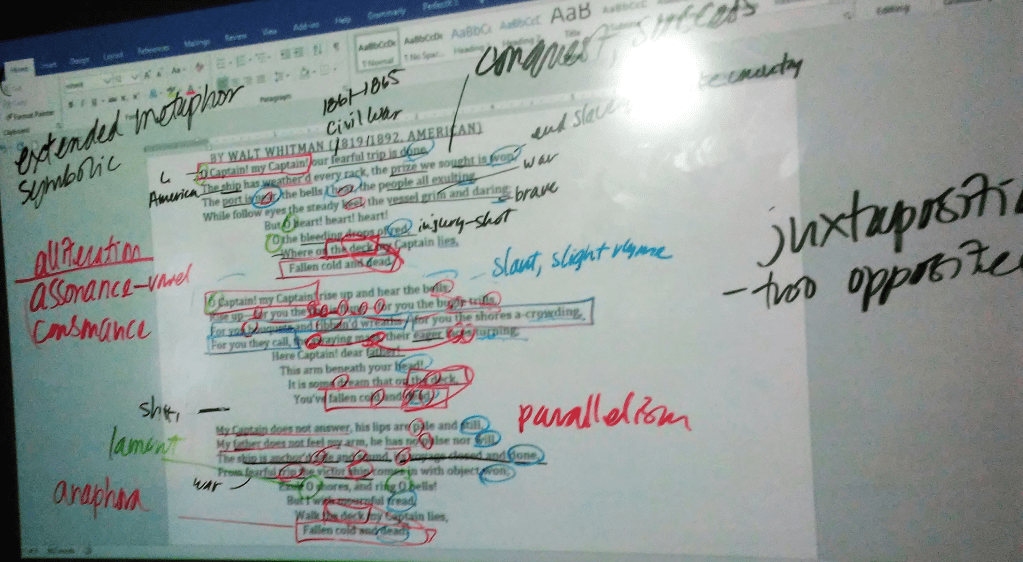
Forgive the quality of my bad camera phone, but here’s a snapshot of what we identified during class Period 1:
(Isn’t that just so satisfying? And there’s even more to find!)
This is what I want you to replicate on your own page–mark up the text however much you can, looking at rhyme schemes, figurative language, symbols, meanings, diction, repeated phrases (anaphora), parallelism, repeated sounds (alliteration, consonance, assonance), etc., and ASK QUESTIONS. For example, why isn’t his rhyme scheme consistent? Why are there slant/close rhymes in some places and not in others? Why is there a shift between the 2nd and 3rd stanzas? What is this about, anyway?!
I want you to find as much as you possible can in each poem, then write down everything you find in a list, or bullet points, or a paragraph if you want, etc. Document your findings because we’ll discuss these when we return from break (on Wednesday, Feb. 26, because I’ll be gone on Monday and Tuesday). Remember to also do the Sentence Combining assignment.
FINISH watching Great Expectations and discuss major themes, as they correlate to # 10, 11, and 12 on your handout.
Major themes covered in class: Education, Key to happiness (is it wealth? status?), Loyalty (who is loyal to whom, and why, and do they deserve that loyalty).
ASSIGNMENT IS DUE THURSDAY BEFORE MIDNIGHT, shared with me on Google Docs.
(We will do a one-page summary of Great Expectations when I return after break.)
Great Expectations Major Themes and Characters, continued
On the handout, you should be able to answer #1 and #3 (and possibly #2) based on what we watched yesterday. You can also make some notes about #9. Begin answering those questions so you have less to do when the assignment is DUE THURSDAY. Remember, the answers should be 2-5 sentences for EACH bullet point, requiring you to make some assessments and evaluate situations, characters, and themes.
You will be graded based on the thoroughness of your explanations. (An answer such as, “I like Havisham. She’s crazy,” will NOT be sufficient.) Your answers on a Google Doc will be due THURSDAY, but we should be able to finish the movie by Wednesday.
Continue watching Great Expectations, and take notes about characters and themes.
Since Friday was a snow day, we get to pack a lot in this week before Winter break next week. Yay, us! (Friday, by the way, will likely not be any class; it’s a half day which is turning into a field day, so we have only four days of class this week, and losing class days isn’t stressing me out whatsoever.)
Great Expectations–Major Characters and Themes
Last week I assigned you to read parables found in the Book of Luke, preferably from the King James Version (KJV) of the Bible, since that’s the language Dickens and many other writers before the 20th century would have referenced.
Good Samaritan, Prodigal Son, Lost Sheep, Lost Coin, Young Rich Man, Rich Man and Lazarus
Good Samaritan—Man walking from Jerusalem to Jericho, a road which went through rough terrain. Thieves attack and leave him for dead. First comes a priest, goes on other side. Then a Levite, same thing. Both of these “pious” men should have rendered assistance. Then comes a Samaritan—hated by the Jews because they were essentially “half-bloods” and didn’t live among the Jews but in Samaria. Considered “Unclean.” He has compassion, takes care of the man, brings him to safety, pays for his care. Most unlikely helper. Who was the “neighbor”?
Lost sheep: A shepherd has 100 sheep, loses one, leaves the rest to find the missing sheep. Rejoices when found. (lost through wandering–innocent and naive, but rescued by someone more capable)
Lost 10 pieces of silver: Woman loses valuable amount of money, searches diligently until she finds it, rejoices to tell everyone about it. (lost through neglect, but earnestly looked for)
Prodigal son: Two sons, one older and obedient, the younger more reckless and thoughtless. He takes his inheritance early. Runs off, spends it all in riotous living, starts to suffer. Takes the lowliest job a Jew could take—swineherd. (Jews would have nothing to do with pigs, since they were considered “unclean”.) Younger son decides he could be servant just as well at home, and goes back penitent, willing to take a lower place in the household as a servant. His father sees him, goes running to greet him, calls for a celebration, and accepts his son back as a full son. Elder son is resentful his younger brother gets a party. Father says, “You’ve never suffered as he has—you’ve had it easier, it’s ok that we rejoice he’s back.” (lost deliberately, returns deliberately and humbled)
Rich Man and Lazarus the beggar, who just wants crumbs. He dies and carried to Abraham. Rich man dies, but finds himself in hell. He sees Lazarus with Abraham and calls for help, but Abraham says, in life you did well but Lazarus didn’t; now it’s reversed. There is a great gulf between us, too. Rich man asks Abraham to send a messenger to warn his five brothers about where they will end up if they don’t help the poor, but Abraham says they’ve been warned by Moses and the prophets, nor will they even listen to one who rises from the dead.
The wealthy and Eternal Life: a wealthy young man asks what more he can do to have Eternal Life (with with God the Father and Jesus Christ after death, and be eventually resurrected), and says that he’s followed the 10 commandments. Jesus then tells him to sell all he has and give it to the poor. The young man leaves, sorrowing, because he is very rich. Jesus says it’s easier for a camel to go through the eye of a needle than for a rich man to enter into heaven.
Each of these parables is “retold” in a manner in Great Expectations. As we go through the major themes, look for the parallels.
Great Expectations illustrations
Waaay back on Thursday I handed out each of you a slip describing part of the story, which I wanted you to illustrate. Let’s see who still has those, and go through your illustrations as we cover the major characters, plots points, and themes of the book.
We’re going to cover this book only by going over the main themes and characters. To do so, we’ll be watching the 2012 movie and completing a writing assignment as we go along. (If you’re a Harry Potter fan, you’ll notice a few familiar faces in the adaptation.)
HANDOUT to be completed during and after watching the movie. I anticipate finishing the movie on Wednesday (but since there is expected weather coming in, that date may change). Take notes on this handout about how you will want to answer the questions, begin answering as you can (on a Google Doc), and be prepared to discuss these major characters and themes on THURSDAY. This writing assignment will be due THURSDAY before midnight, shared with me on Google docs.
START WATCHING THE MOVIE IN CLASS (provided we don’t have a 2-hour delay because of weather issues again . . .) So we had a 1-hour delay, but we were able to start the movie and got to around minute 24. Continue watching tomorrow.
2) ALSO read the following parables, which are alluded to, in Great Expectations. Many authors from the 17th through the 20th centuries pulled ideas, images, lessons, and stories from the Bible. It was the most widely-known book for hundreds of years; even peasants unable to read were familiar with the more common parables of Christ–stories that Jesus Christ (circa 1-34 AD) told to convey lessons.
Great Expectations draws upon several of these parables–ALLUSIONS, which are references to another work–essentially retelling these parables in the context of 1812-1840s Victorian England. If readers aren’t familiar with the parables, they miss important themes and ideas in the text. These parables are among the most well-known, their themes cropping up in a wide variety of novels, plays, and poetry.
Parables to read, in the King James Version (KJV), please–that’s the language Dickens and most of the authors would have been familiar with. You may read the photocopied pages I gave in class, read your own Bible, look up these versus on Google, or click on the links I’ve provided below.
Good Samaritan, Prodigal Son, Lost Sheep, Lost Coin, Young Rich Man, Rich Man and Lazarus
3) Remember to create the illustration of your segment of the story I handed out to you in class. Stick figures are absolutely fine. (If you spend more than 20 minutes on this illustration, you’re taking it too seriously.) However, if you’re bored like Talita was last year, and have a couple of hours to burn, you may certainly create a work of art to present to the class, as she did:
(Insanely amazing, right? But seriously, you may draw stick figures.)
REMEMBER that Part 2 of your EARNEST ESSAY is due FRIDAY before midnight.
1) Choose 15 direct quotes (5 from each of the 3 acts) that are meaningful sentences or phrases that support any of the following comedic themes within the play:
The nature of marriage
The constraints of morality
The quest for truth and beauty
Hypocrisy
Type each quote and add a sentence of why you chose that quote: what appealed to you about it? Did you find it accurate? How? Funny? Why? Insightful? In what way?
2) Free Response Prompt
The three prompts below have appeared in past AP exams, and Earnest could be used to answer each of these. Choose ONE of the prompts that appeals to you the most, and write an essay.
2a) Create a clear, defensible claim and list three supports for the claim. SUBMIT this to Mrs. Mercer FIRST before writing the essay, before WEDNESDAY at MIDNIGHT.
2b) Once I have approved your claim (or given suggestions for revision), WRITE THE FULL ESSAY. This essay will be completed on Google docs, double-spaced, and be a minimum of 350 words.
Many works of literature contain a character who intentionally deceives others. The character’s dishonesty many be intended either to help or to hurt. Such a character, for example, may choose to mislead others for personal safety or to spare someone’s feelings, or to even carry out a crime. Choose a novel or a play in which a character deceives others. Then, analyze the motives for that character’s deception and discuss how the deception contributes to the meaning of the work as a whole.
Some novels and plays seem to advocate changes in social or political attitudes, or in traditions. Choose such a novel or play and note briefly the particular attitudes or traditions that the author apparently wishes to modify. Analyze the techniques the author uses to influence the reader’s or the audience’s views.
Many plays and novels use contrasting places (for example, two countries, two cities or towns, two houses, or the land and the sea) to represent opposed forces or ideas that are central to the meaning of the work. Choose a novel or a play that contrasts two such places. Write an essay on how the places differ, what each place represents, and how their contrast contributes to the meaning of the work.
This essay and the 15 lines will be due FRIDAY before midnight.
QUIZ on Tuesday over the next 15 Literary Terms.
WATCH The Importance of Being Earnest. (First part)
FINISH reading The Importance of Being Earnest in class
Complete Text Summary page for the work. We will complete one of these for every major work we read; it will serve as a good review when it’s time for the test. (Will need to finish tomorrow.)
Continue reading The Importance of Being Earnest in class.
Discuss characterization and settings–how does the setting shift from city to country? What occurs to the characters, especially Jack and Algernon, when they change settings?
Remember to record your favorite lines (5 from each act for a total of 15 lines) on:
The nature of marriage
The constraints of morality
The quest for truth and beauty
Hypocrisy
Type each quote and organize the quotes based on Act 1, Act 2, and Act 3, and add a sentence of why you chose that quote:
What appealed to you about it?
Did you find it accurate? How?
Funny? Why?
Insightful? In what way?
HOMEWORK: Complete your essay on a major theme in “Do not go gentle into that good night” and share it with me before midnight tonight!
QUIZ on the next 15 Lit terms will be on TUESDAY next week.

 AP Lit, Washington Academy